
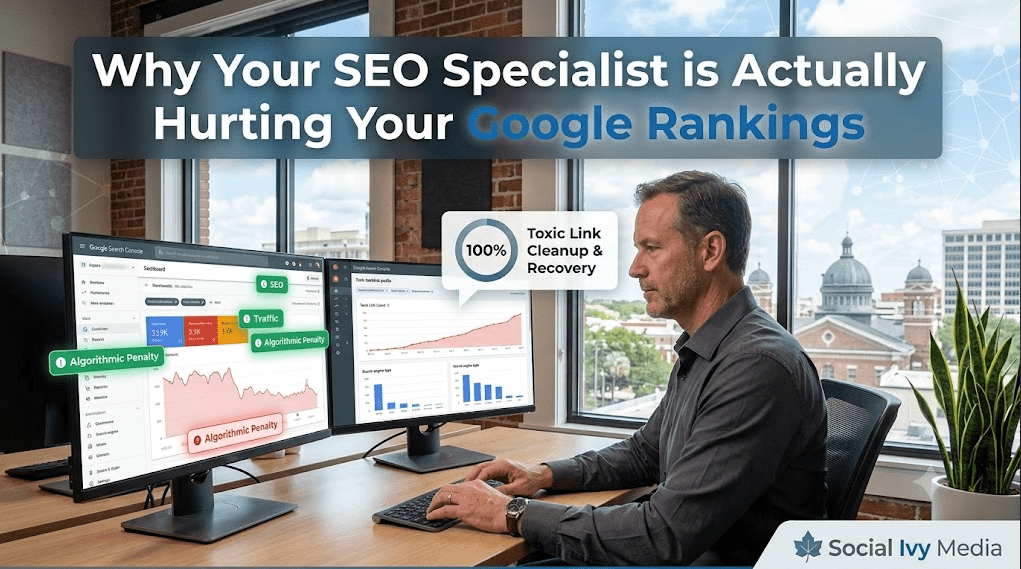
Why Your “SEO Specialist” is Actually Hurting Your Google Rankings.
The 2026 Digital Fatigue Problem and Toxic SEO Business owners across St. Petersburg and the greater Tampa Bay region frequently discover that their organic search visibility is completely stalled—or actively declining—despite paying a monthly retainer to an external search optimization provider. For years, the digital marketing industry was flooded with low-cost providers promising rapid first-page rankings through automated submissions, spun blog articles, and low-quality directory links. Today, modern search algorithms easily detect and penalize these outdated techniques, leaving companies with stagnant traffic and rising customer acquisition costs. When businesses partner with agencies that rely on shortcut tactics, they face double exposure. Not only do they waste monthly marketing capital on non-performing work, but their domain authority takes a direct hit from search engine quality filters. As paid ad costs continue to climb and organic competition intensifies, relying on an underperforming or toxic search provider creates severe vulnerability in your revenue pipeline. Correcting this trajectory requires engaging professional SEO Consulting Services that prioritize rigorous technical auditing, transparent execution, and sustainable semantic growth. Replacing superficial tactics with a structured search architecture protects your brand online and transforms search engines into a reliable, high-margin revenue generator. The Diagnostic: Why Standard SEO Packages Fail Businesses Standardized SEO packages consistently fail mid-market companies and local service providers because they treat search engine optimization like a commodity checklist rather than a technical engineering discipline. Agencies selling cheap monthly packages typically rely on mass-produced blog posts and automated outreach campaigns that violate search engine quality guidelines. When rankings drop, these providers often blame algorithm updates while continuing to collect retainers for ineffective work. When business leaders rely on generic service providers, they rarely receive a clear explanation of how their marketing budget is deployed. True search optimization requires deep technical analysis, continuous site speed tuning, structured JSON-LD schema implementation, and meticulous internal link architecture. Neglecting these foundational requirements leaves your digital footprint exposed to algorithmic volatility. Furthermore, separating search optimization from your overall conversion framework ensures that any traffic you do receive will leak out of your sales funnel. Securing top search positions yields zero commercial value if incoming visitors land on a slow, unoptimized website with no clear call to action or immediate messaging tools. A comprehensive diagnostic evaluates both technical search compliance and conversion efficiency. The Corrective Solution: Restoring Search Authority Fixing a toxic or stagnant search profile requires a systematic, engineering-first approach. Engaging professional SEO Consulting Services allows your organization to audit existing liabilities, disavow harmful backlinks, restructure content hierarchies, and build a resilient search presence aligned with modern search mechanics. Rebuilding search authority starts with a complete technical audit. Partnering with a specialized local seo company in st petersburg fl ensures that your foundational local citations, Google Business Profile settings, and geographic schema are cleansed of errors and optimized for maximum regional visibility. Continuing to fund an agency that uses outdated SEO tactics is actively burning capital while damaging your brand’s digital reputation. True search recovery requires a transparent, technical overhaul that replaces spammy shortcuts with sustainable, entity-driven authority. Supporting a clean search profile requires an elite website infrastructure engineered through professional Website Design & Development. High-performance sites load instantly on mobile networks, feature clean code architectures, and provide clear navigation pathways for both search crawlers and human buyers. To capture active searchers immediately, integrating real-time Live Chat Lead Conversion allows prospective clients to start conversations instantly from search landing pages. Maintaining a balanced acquisition ecosystem requires diversifying lead sources. Pairing organic search recovery with targeted Pay Per Click (PPC) Traffic secures immediate visibility while organic rankings recover from previous penalties. Additionally, reinforcing brand trust through active Social Media Management & Marketing builds authentic engagement signals that validate your brand entity to search engines. Measuring SEO Recovery and the Cost of Inaction Evaluating corrective search investments requires comparing the financial damage of ongoing algorithmic penalties against the compounding returns of a clean, high-performing organic growth engine. Continuing to retain a subpar provider or ignoring toxic link profiles allows competitors to capture your rightful market share. Scenario Typical Result Cost of Inaction Time to ROI Amateur / DIY Approach Persistent algorithmic penalties, toxic backlink exposure, zero organic growth, wasted budget Severe loss of domain equity, ongoing customer acquisition cost inflation 12–18 Months (Uncertain) Social Ivy Approach Clean backlink profile, restored search visibility, direct lead tracking, predictable revenue Minimal—corrective optimization builds permanent, compounding digital value 3–6 Months Industry analysis published by Search Engine Journal highlights that recovering from unnatural link penalties requires aggressive auditing, explicit disavowal files, and a total pivot toward high-value, intent-driven content clusters. Technical benchmarks from Moz confirm that websites operating with clean, optimized technical architectures experience rapid ranking recovery following algorithm updates. Furthermore, economic data compiled by Statista indicates that businesses recovering their organic search footing achieve significantly higher long-term gross margins compared to those permanently reliant on paid ad spend. Failing to address poor SEO performance leaves your company vulnerable to continued margin erosion and lost regional opportunities. Investing in professional search consulting protects your digital assets, eliminates wasted spend, and restores predictable inbound lead flow. Why Social Ivy Media Drives Real Revenue Social Ivy Media operates as a growth consulting and digital engineering agency based in St. Petersburg, Florida. We specialize in auditing broken marketing campaigns, correcting toxic technical setups, and engineering high-performing growth engines for businesses across the Tampa Bay region and nationwide. Led by CEO Dion De Lauder, our team eliminates agency fluff and vanity metrics, focusing entirely on transparency, technical rigor, and bottom-line commercial growth. Our agency operates using an AGILE execution framework, enabling rapid diagnostic assessments, immediate technical interventions, and continuous data-driven optimization. We do not rely on rigid, one-size-fits-all optimization packages. Instead, we customize our search, web, and conversion engineering to match your exact business model and revenue targets. Partnering with a specialized team that understands complex search algorithms gives your organization a decisive competitive edge. We bring deep technical expertise and regional market awareness to every engagement, ensuring your digital footprint drives
Why Your “SEO Specialist” is Actually Hurting Your Google Rankings. Read More »