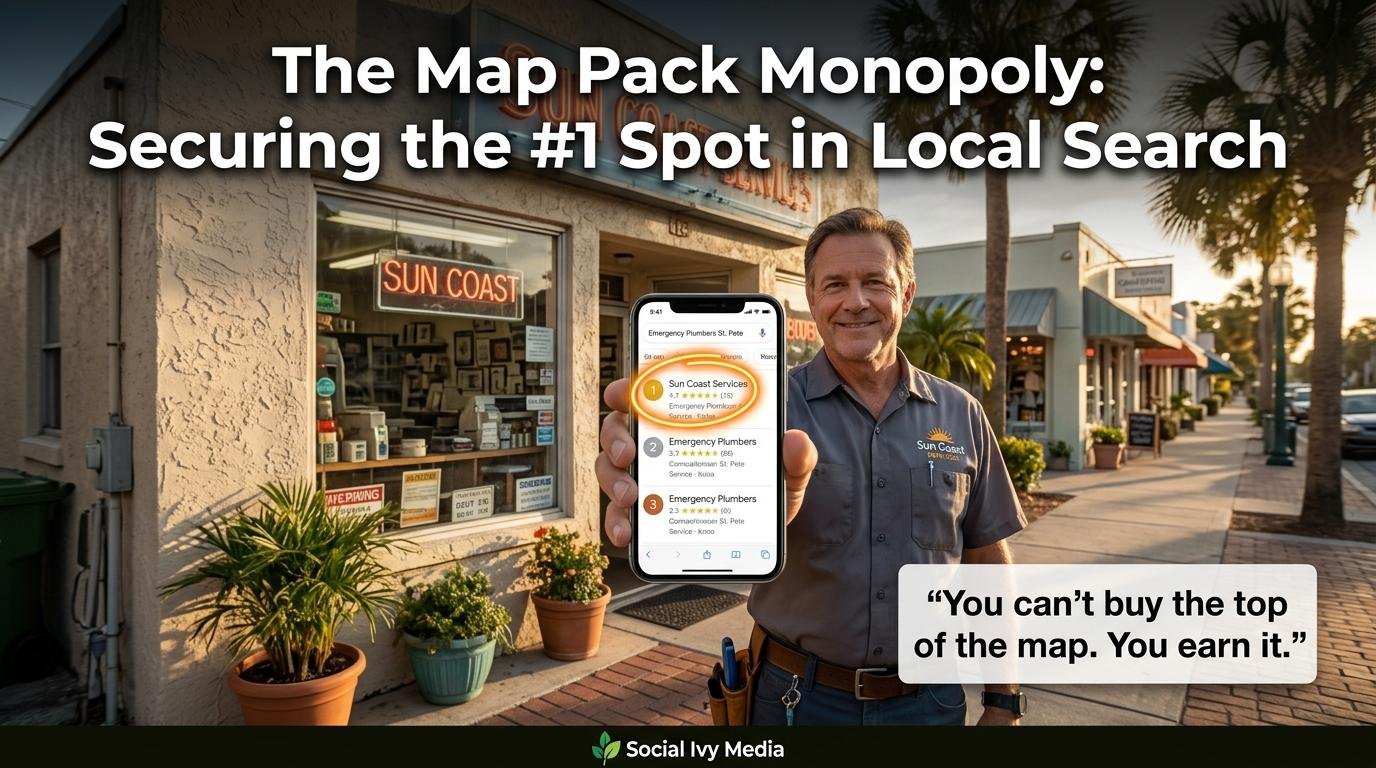

Search your own service on your phone. If three competitors appear in the map with stars, photos, and a tap-to-call button and you don’t, no amount of social posting makes up for it. That’s digital fatigue: rising acquisition costs, crowded ad auctions, shrinking organic reach, and disconnected tools producing activity you can’t trace to revenue. Google Map Pack ranking is one of the few places where proximity-driven demand still shows up as phone calls instead of impressions.
The Map Pack, often called the local 3-pack, is the block of three business listings Google shows when a search has local intent: “AC repair near me,” “plumber St. Petersburg,” “dentist Clearwater.” It is built primarily from Google Business Profiles, with your website and the wider web serving as supporting evidence. That’s why a business with an average website and a strong profile can outrank a better-built competitor, and why the best site in Pinellas County won’t help if the profile is neglected.
Here is the honest part that “guaranteed #1” pitches skip. Nobody controls the map pack. Google decides, results shift with the searcher’s exact location, and the rules change often; Search Engine Journal regularly covers those shifts. What you can control is whether your business is a complete, consistent, trusted, and easy-to-contact answer. Treating the pack like a trophy to win once is how owners end up chasing screenshots instead of customers.
First, the diagnostic: why most local businesses stay out of the pack even when they’re doing “a lot” of marketing.

The Diagnostic
Generic marketing fails here because the map pack isn’t a content problem. It’s a relevance, distance, and trust problem, scored in seconds each time someone searches. Google has said publicly that local results rely mainly on three factors. Relevance is how well your profile matches the search. Distance is how far you are from the searcher or the location they named. Prominence is how well known and trusted you appear, drawn from reviews, links, citations, and your broader web presence.
Most owners misread that in four ways.
Claim and forget. Verifying a profile and walking away is like unlocking the shop and leaving the shelves empty. Wrong categories, missing services, outdated hours, and no photos tell Google, and customers, that nobody is minding the store.
Chasing a single “#1.” Local rankings are geographic. A business can lead the pack for a searcher standing near its shop and vanish for one a mile away. Anyone selling you a single rank number hasn’t shown you what your customers actually see.
Reviews without a system. Review volume, recency, ratings, and how you respond all feed prominence, and they persuade the human choosing among three options. A burst of reviews after one push, followed by silence, is weaker than a steady, genuine flow.
Website-only thinking. Money goes into the site while the profile carries inconsistent phone numbers and generic descriptions. In this contest the profile is the storefront.
Underneath all four is the gap between marketing activity and a measurable growth system. Strong Google Map Pack ranking depends on profile, reviews, local web presence, and conversion path working together. When any one is left to chance, the others underperform.
[STRATEGIST WARNING] The costliest shortcuts we see are stuffing keywords into the business name, using a virtual office or fake address, and buying or gating reviews. Google’s guidelines prohibit these, and the consequence is a suspended or removed profile. You lose the reviews you earned, rebuild from zero, and give up weeks or months of inbound calls while competitors hold your spot.
The Solution: A System for Google Map Pack Ranking
Three jobs, one system: earn relevance, work around distance, and build prominence. Then make sure the click turns into a customer.
Get relevance right
Start with accuracy, not cleverness. Choose the primary category that best describes the core of your business, add secondary categories that are genuinely true, and list every service you actually perform. Write a description for people, not an algorithm. Use your real business name. Many owners still call this work Google My Business SEO in St. Petersburg, though the product is now Google Business Profile, and the principle hasn’t changed: your profile should read like the most precise answer to the search.
Your website must back the profile up. Dedicated service pages and genuine location pages, built through website design and development that treats local intent as a design requirement, give Google and customers consistent evidence that you do what the profile says, where it says.
Work around the distance you can’t change
You can’t move your shop. If a competitor sits closer to the searcher, you won’t out-optimize geography on every query, so pick your battles. Define your service areas honestly, concentrate on the neighborhoods where you win jobs profitably, and build local evidence there: reviews that mention the work and the area, local partnerships, and pages written for those places. In a market like Tampa Bay, a St. Pete business and a Tampa business may both be “local” but compete for different blocks of searchers.
Build prominence deliberately
Prominence is the slowest lever and the most durable. It comes from a steady flow of genuine reviews, thoughtful replies to all of them, consistent name, address, and phone details across directories, and mentions or links from local organizations and press. Online reputation management for a local business is less about crisis control and more about a compliant, repeatable system: ask every satisfied customer, make it easy, respond within days, and never buy or gate reviews. Our review and reputation management work builds that cadence, and local reputation management of this kind compounds. Moz, which has built local SEO tools and published local SEO guidance for years, is a useful outside reference on how these signals fit together.
Run it as one program
A structured local and competitive SEO program ties relevance, distance strategy, and prominence into a single plan with a measurement layer. That’s what separates small business SEO that produces calls from a checklist that produces screenshots: someone owns the whole system, tracks it by neighborhood, and adjusts.
You can’t buy a permanent spot in the map pack; you can only earn the right to be shown. The business that wins is the one that’s the most relevant, most trusted, and easiest to contact in the exact place the customer is standing.
Measure what pays
Track calls, direction requests, website clicks, and messages from the profile, then match them to booked jobs. A ranking grid by neighborhood is useful, but it’s a diagnostic, not the goal. The goal is revenue you can trace to the profile.
Data and ROI
Good-enough local marketing costs you the calls you never see, because the customer who chose a competitor from the pack never shows up in your reports.
Statista’s consumer research regularly shows online reviews influencing local buying decisions, which is why prominence signals matter to people and not only to Google. Visibility without credibility doesn’t convert, and credibility without visibility never gets the chance.
Here is an illustrative estimate, not measured performance. Assume a St. Petersburg service business appears in about 300 map pack views a month, an average ticket of $350, and 30% of calls and direction requests becoming booked jobs. A neglected profile with few reviews and incomplete information might turn about 4% of views into action, roughly 12 calls or direction requests, about 4 booked jobs, and $1,400. A complete, well-reviewed profile might turn about 10% into action, roughly 30 actions, about 9 booked jobs, and $3,150. The gap is about $1,750 a month, or $21,000 a year. The estimate excludes the cost of doing the work, repeat customers, seasonality, and the strong possibility that your market’s numbers differ.
| Scenario | Typical Result | Cost of Inaction | Time to ROI |
|---|---|---|---|
| Amateur / DIY Approach: claimed profile, set and forget, few reviews | Inconsistent appearances and a low action rate (about 12 actions a month in the estimate) | Roughly $1,750 a month in revenue left behind versus the optimized example | Unclear; without call and job tracking, ROI can’t be confirmed |
| Amateur / DIY Approach: keyword-stuffed name, fake address, or bought reviews | A possible short-term bump at best | Suspension or removal, lost reviews, and a rebuild from zero | Unpredictable; potentially negative |
| Social Ivy Approach: accurate profile, consistent citations, steady review program, local pages, tracked calls | About 30 actions a month and 9 booked jobs in the estimate | Handing those calls to the competitors the pack does show | Depends on industry, budget, competition, and implementation |
| Social Ivy Approach: map pack visibility paired with reputation and a fast response path | Visibility reinforced by trust and quick follow-up | Winning the view but losing the job to a slower reply | Depends on industry, budget, competition, and implementation |
The KPIs that matter are profile calls, direction requests, website clicks, review count and recency, average rating, visibility by neighborhood, booked jobs by source, and cost per booked job. Ranking screenshots are not on that list. Visitors who find you from the map often want an answer now, and live chat lead conversion captures the ones who would rather type than call.
We don’t promise fixed timelines. Local visibility compounds, but how fast depends on industry, budget, competition, and implementation, and your starting point matters more than any benchmark.
Why Social Ivy Media
We’re a St. Petersburg agency, and for local search that is more than a mailing address. As a local SEO company in St. Petersburg, FL, we work the same streets, neighborhoods, and seasons as our clients, and we know that a search from Old Northeast doesn’t behave like one from Largo. Our team is led by CEO Dion De Lauder, and we work from an AGILE marketing approach: make a defined change, read the data, and adjust, instead of locking a plan for a year and hoping.
Map pack visibility is rarely won by one tactic, which is why cross-channel strategy matters. The profile is local SEO. The pages behind it are web design. The reviews are reputation work. The call or chat that follows is funnel and response design. Social content and paid media can reinforce all of it. When different vendors own those pieces, each reports its own success and nobody owns the result. When one team manages them as a system, we can tell you which change produced which calls and where the leak is.
We’ll also tell you when the map pack isn’t your biggest problem. If your site is slow on a phone, nobody answers after hours, or your reviews have stalled, those issues cost more than any ranking can recover. We don’t guarantee rankings, leads, or revenue, because no honest agency can. We offer a clear diagnosis, measurable targets, and reporting tied to jobs.
The Journey
Audit
We review your Google Business Profile, categories, services, citations, reviews, website local pages, call handling, and your visibility across your service area compared with competitors. You can expect a plain-language diagnosis. We need profile access (as a manager, not your password), your real service areas, job values, and call or CRM data. We handle the analysis and written findings.
Strategy
We prioritize fixes by impact, define the review program, plan local pages, and set success metrics. You confirm services, service areas, and capacity, so we don’t send demand you can’t serve. We handle the plan and measurement design.
Launch
We update the profile, clean up inconsistent listings, build or improve local pages, set up call and conversion tracking, and put the review process in place. You supply real photos, accurate details, and the habit of asking customers. We handle implementation and quality checks.
Optimize and Scale
We monitor visibility, calls, and booked jobs, respond to changes in Google’s behavior, and expand to new neighborhoods or services when the data supports it. You report job outcomes so results flow back into the work. We handle analysis and reporting.
Outcomes depend on industry, budget, competition, and implementation, so we don’t set fixed timelines, ranking promises, or revenue promises.
The Fix Starts with a Strategy Session
Google Map Pack ranking rewards the business that is the clearest, most trusted, and easiest-to-reach answer in the exact place a customer is standing. You can’t buy that, and you shouldn’t try to fake it. You can build it with an accurate profile, a steady review system, strong local web presence, and tracking that ties visibility to booked jobs. The lesson of digital fatigue holds here too: more spend isn’t the fix. Diagnosis is.
That’s why we frame the next step as a growth diagnostic, not a sales call and not a content request. In a strategy session, we look at where your profile, reviews, and local presence leak calls, which parts of your service area are winnable, and what to measure so you know it’s working. You leave with a clearer picture whether or not we work together.
Book a strategy session: [INSERT STRATEGY SESSION URL]
Prefer to talk first? Call [INSERT PHONE NUMBER] or email [INSERT EMAIL ADDRESS].
Want to read more first? See how our local SEO service approaches profile optimization, local pages, and tracking.
About the Author
Social Ivy Media — Growth Strategy Team
St. Petersburg, FL | Serving Tampa Bay Since [Year]
Social Ivy Media is a full-service digital marketing agency based in St. Petersburg, Florida, led by CEO Dion De Lauder. We help local and regional businesses grow through integrated SEO, paid media, social, website design, and funnel strategy — built to convert, not just to look good.
🌐 socialivymedia.com
📍 St. Petersburg, FL