

Most service business owners describe the same cycle. You boost a post, run a few ads, pay for a directory listing, and hear that you need to be on every channel. The invoices keep arriving. The phone doesn’t ring any more than it did before. That is digital fatigue: rising acquisition costs, crowded ad auctions, shrinking organic reach, and disconnected tools that produce plenty of activity and very little revenue you can trace.
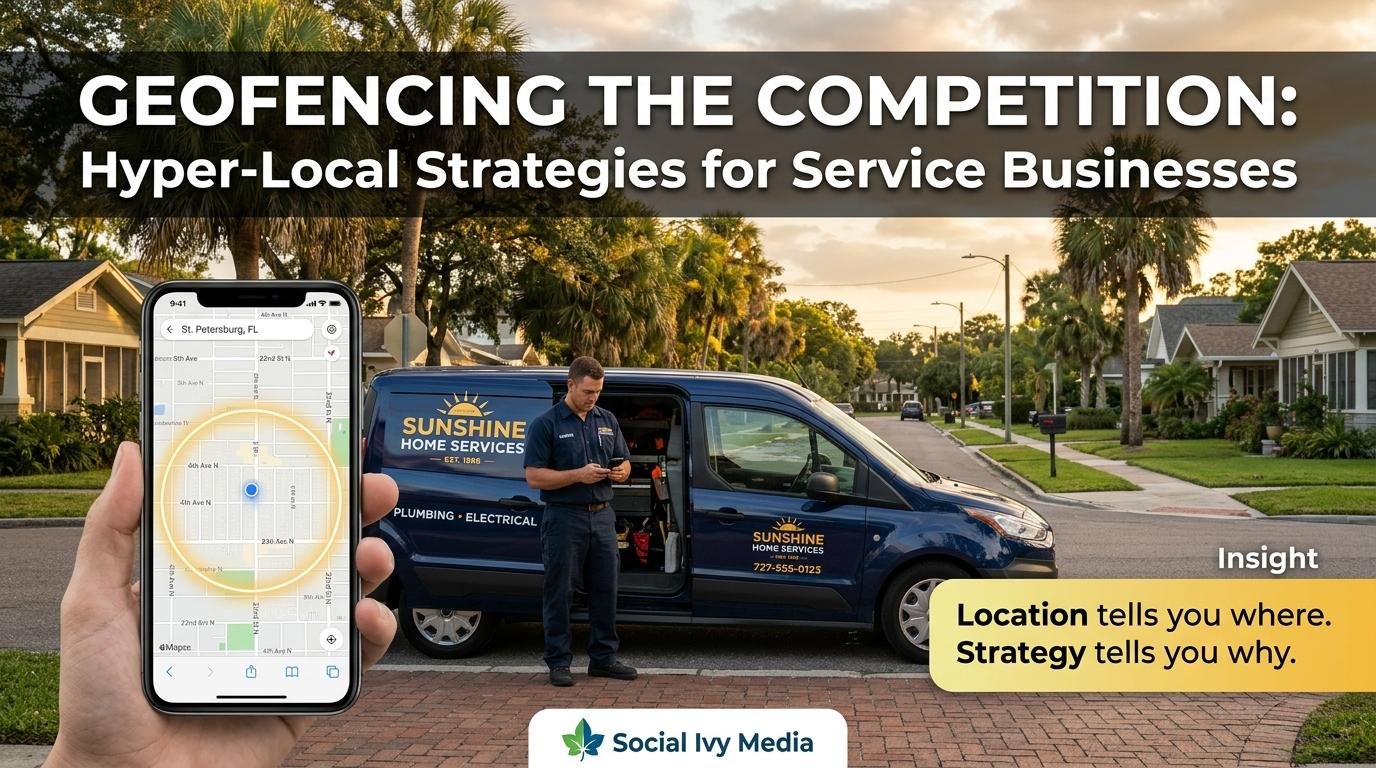
Geofencing for service businesses is one of the few tactics that pushes back against that fatigue, because it concentrates spend where your customers physically are. A geofence is a virtual boundary drawn around a real place: a neighborhood, a cluster of ZIP codes, a supply house, even a competitor’s storefront. When a person with a location-enabled phone enters that boundary, an ad platform can show them your message. For a plumber, HVAC contractor, roofer, or med spa, that is a different proposition than paying to reach all of Florida when you only drive to Pinellas County.
But geofencing has become a buzzword sold as a magic trick. It isn’t one. Location is a targeting filter, nothing more. It won’t fix a weak offer, a slow website, a missed call, or tracking that can’t tell you which ad produced which job. Add the pace of change, since Search Engine Journal keeps documenting how often ad platforms and search results shift, and last year’s playbook ages fast. We’ve watched owners run months of tight-radius campaigns and conclude that “digital doesn’t work” when the failure sat in what happened after the click.
This guide is for owners deciding between DIY, an in-house hire, and an agency. We’ll cover what hyper-local targeting can and can’t do, where it breaks, what a working system includes, and how to measure it in leads and booked jobs. First, the diagnostic: why most location-based campaigns underperform.

The Diagnostic
Generic marketing fails at the local level for one reason: it optimizes for reach, and service businesses live on timing and proximity. A homeowner whose water heater just failed doesn’t browse. They search, tap, call the first credible option, and move on. Marketing that reaches thousands of people who might need you someday loses to marketing that reaches the dozens who need you today.
Piecemeal approaches go wrong in four predictable ways.
Radius without intent. A five-mile circle around your shop reaches everyone in it, including renters who can’t authorize repairs, commuters passing through, and people with no active need. Location tells you where a person is. It says nothing about why.
Ads without a destination. Paid traffic that lands on a homepage built like a brochure forces the visitor to hunt for a phone number. Mobile visitors, exactly who geofencing reaches, leave within seconds. A page built for one offer and one action converts differently than a general site, and that is a website design and development problem as much as a media problem.
Channels that don’t share data. The ad platform reports clicks. The phone system reports calls. The office manager’s notebook reports jobs. When none of these connect, “it’s not working” and “it’s working great” are equally unprovable.
Competitor fencing without a plan. Targeting people near a competitor sounds aggressive. Without a reason for those people to choose you, you’re paying to introduce yourself to someone already in the middle of buying from someone else.
Underneath all four sits the same gap: marketing activity versus a measurable growth system. Geofencing for service businesses works when location, offer, landing experience, response time, and tracking are designed together. It stalls when any one of them is left to chance.
[STRATEGIST WARNING] The two most expensive mistakes we see are buying a tight geofence and sending it to a generic homepage, and judging results by clicks. A campaign that delivers 400 clicks and zero tracked calls isn’t a cheap test. It’s budget spent with no way to learn from it, and it often convinces owners to abandon a channel that was never set up to succeed.
The Solution: Geofencing for Service Businesses Done as a System
A working program has five connected parts. Remove one and the others underperform.
Define fences around moments, not just maps
Start with three fence types, in this order:
- Service-area fences. Your real drive zones, ranked by profitability. Neighborhoods where you complete jobs efficiently deserve more budget than the far edge of your territory.
- Intent fences. Places where need is visible, such as supply houses, appliance retailers, or older housing pockets where equipment is likely aging out.
- Competitor fences. Test these only after the first two produce data. You need a reason for a competitor’s customer to switch, such as faster scheduling, clear pricing, or stronger reviews.
Keep fences tight but realistic. A boundary that is too small starves the campaign of volume. One that is too large turns it back into broad targeting.
Match the channel to the intent
Most location targeting runs through paid search, display, and paid social. The quality of your PPC traffic depends on negative keywords, device and hour-of-day controls, and ad copy that matches the moment, which is the discipline behind our pay-per-click advertising services. Paid social media marketing suits awareness and retargeting: a service-area audience sees a seasonal offer, then a reminder after visiting your site. Judge it by social media advertising ROI, meaning booked jobs against spend, not likes or reach.
Let local search catch the follow-up
Geofencing is paid. Local search is earned. A homeowner who sees your ad and then searches your name will judge your listing, reviews, and service pages in seconds. Many owners still call this Google My Business SEO in St. Petersburg, though the product is now Google Business Profile: accurate categories and service areas, current photos, and a steady flow of genuine reviews. Our local and competitive SEO work covers that foundation, and the same discipline applies to small business SEO across Tampa Bay. If the free listing is weak, your paid traffic is covering for the gap. Moz publishes ongoing research on local search ranking factors, a useful outside reference for why relevance, prominence, and proximity shape who appears in map results.
Build the destination and the follow-up
Every click needs a path. That means a campaign-specific page with one offer, a tap-to-call button, a short form, an instant text or email confirmation, and a plan for after-hours inquiries. This is the work of sales and marketing funnel design: defining what happens in the first five minutes after someone responds, because speed often decides who gets the job.
A radius tells you where someone is standing; a strategy tells you why they should call you. Piecemeal tactics buy attention in isolation, while an integrated system turns that attention into a booked job and then proves it did.
Measure what pays and respect the limits
Use call tracking, form tracking, and a booked-jobs report tied to each campaign. Report cost per booked job and revenue per ad dollar, not impressions. Know the limits too. Location data is probabilistic, not exact, and accuracy varies by device and settings. Platforms restrict targeting around certain sensitive places, and state privacy rules for location data keep evolving. We build within platform policies and recommend legal review for regulated industries such as healthcare.
Data and ROI
Good-enough marketing is the most expensive kind, because its cost shows up as wasted spend and missed jobs instead of a line item.
Start with the market pressure. Statista’s market data consistently shows digital advertising taking a growing share of overall ad budgets, which means more businesses bidding for the same nearby customers. Rising competition is a reason to spend more precisely, and geofencing for service businesses is a precision tool, but only when the numbers behind it are real.
Here is an illustrative estimate, not measured performance. Assume $1,500 a month in ad spend, 12 inquiries a month in both scenarios, and an average ticket of $400. In the DIY scenario, ads send people to a homepage, after-hours calls go unanswered, and nothing is tracked, so roughly 2 of 12 inquiries become booked jobs. That’s about $800 in revenue and $750 per booked job. In the structured scenario, a dedicated page, call tracking, and fast follow-up convert roughly 4 of 12, which is about $1,600 in revenue and $375 per booked job. The spend is identical. The gap is about $800 a month, or $9,600 a year, and it comes entirely from what happens after the click. Real results vary with job value, margins, close rates, seasonality, and competition, and this example ignores repeat business and referrals.
| Scenario | Typical Result | Cost of Inaction | Time to ROI |
|---|---|---|---|
| Amateur / DIY Approach: radius ads sent to a generic homepage | About 2 booked jobs from 12 inquiries (estimate) | About $750 per booked job; roughly $800 a month in revenue left behind versus the structured example | Unclear; without call and job tracking, ROI can’t be confirmed |
| Amateur / DIY Approach: boosted posts with no tracking | Impressions and engagement, little attributable revenue | Ongoing spend with nothing to learn from | Unknown |
| Social Ivy Approach: geofenced campaigns with a dedicated page, call tracking, and fast follow-up | About 4 booked jobs from 12 inquiries at the same spend (estimate) | About $375 per booked job under the same assumptions | Depends on industry, budget, competition, and implementation |
| Social Ivy Approach: geofencing paired with local SEO and review building | Paid reach reinforced by search visibility and reputation | Paying to reach customers who then choose a competitor’s stronger listing | Depends on industry, budget, competition, and implementation |
The KPIs that matter are cost per lead, cost per booked job, call answer rate, form-to-booking rate, revenue per ad dollar, and share of new customers by source. Impressions and click-through rate are diagnostic signals, not proof of success. Mobile visitors from a geofence often prefer to text or chat rather than call, and live chat lead conversion gives them a lower-friction route while you’re on a job site.
For measurement and data practices, the Association of National Advertisers (ANA) publishes industry guidance on advertising measurement and data use, a reasonable reference when deciding how far to trust any platform’s own reporting.
We don’t promise fixed timelines. Payback depends on industry, budget, competition, and implementation, and a campaign still in its learning phase should be judged on cost per booked job against your margin, not on week-one volume.
Why Social Ivy Media
We’re a St. Petersburg agency, and that matters for this kind of work. Service-area marketing depends on knowing how Tampa Bay customers search, which neighborhoods are worth the drive time, and how seasonal demand shifts across Pinellas, Hillsborough, and Pasco counties. Our team is led by CEO Dion De Lauder, and we work from an AGILE marketing approach: launch a defined test, read the data, and adjust, instead of locking a plan for twelve months and hoping.
Geofencing rarely succeeds as a standalone tactic, which is why cross-channel strategy matters. The fence itself is paid media. The landing page is web design. The follow-up is funnel design and response handling. The listing a prospect checks next is local SEO. When separate vendors manage those pieces, nobody owns the result and each reports its own success. When they’re managed as one system, we can tell you which campaign produced which booked job and where the leak is.
We’ll also tell you when geofencing isn’t the right next step. If your Google Business Profile is neglected, your site doesn’t load well on a phone, or nobody answers after hours, those problems cost more than any ad can fix. We’d rather diagnose that in a strategy session than sell you impressions. We don’t guarantee rankings, leads, or revenue, because no honest agency can. What we offer is a clear diagnosis, measurable targets, and reporting tied to jobs.
The Journey
Audit
We review your service area, current ads, website and landing pages, Google Business Profile, call handling, and tracking. You can expect a plain-language diagnosis of where leads are lost. We need access to your ad accounts, analytics, and listing, plus your call or CRM data and your real job values and margins. We handle the technical review and the written findings.
Strategy
We choose fence types, channels, offers, budget split, and success metrics. You approve the offer and confirm service areas and crew capacity, so we don’t send more work than you can complete. We handle the plan and the measurement design.
Launch
We build campaign pages, set up call and form tracking, configure the geofenced campaigns, and test everything on a phone before spend begins. Expect a short testing period. Your part is answering calls promptly and telling us which jobs you want more of. We handle builds, setup, and quality checks.
Optimize and Scale
We review booked-job data, trim weak fences, shift budget, and test new offers. You report job outcomes so real results flow back into the campaigns. We add fences or channels only when the data supports it, and we handle the analysis and reporting.
Outcomes depend on industry, budget, competition, and implementation, so we don’t set fixed timelines, ranking promises, or revenue promises.
The Fix Starts with a Strategy Session
Geofencing for service businesses works when location is one input to a system: a defined fence, an offer worth responding to, a destination built for mobile, fast follow-up, and tracking that ties spend to booked jobs. It fails when it’s bought as a standalone trick. The central lesson of digital fatigue is that more spend isn’t the fix. Diagnosis is.
That’s why we frame the next step as a growth diagnostic, not a sales call and not a content request. In a strategy session, we look at where your current marketing leaks, whether geofencing belongs in your plan now or later, and what you’d need to measure to know it’s paying. You leave with a clearer picture whether or not we work together, and you’ll know what to fix before you spend another dollar.
Book a strategy session: [INSERT STRATEGY SESSION URL]
Prefer to talk first? Call [INSERT PHONE NUMBER] or email [INSERT EMAIL ADDRESS].
Want to read more first? See how our pay-per-click advertising program handles targeting, tracking, and reporting for local businesses.
About the Author
Social Ivy Media — Growth Strategy Team
St. Petersburg, FL | Serving Tampa Bay Since [Year]
Social Ivy Media is a full-service digital marketing agency based in St. Petersburg, Florida, led by CEO Dion De Lauder. We help local and regional businesses grow through integrated SEO, paid media, social, website design, and funnel strategy — built to convert, not just to look good.
🌐 socialivymedia.com
📍 St. Petersburg, FL