
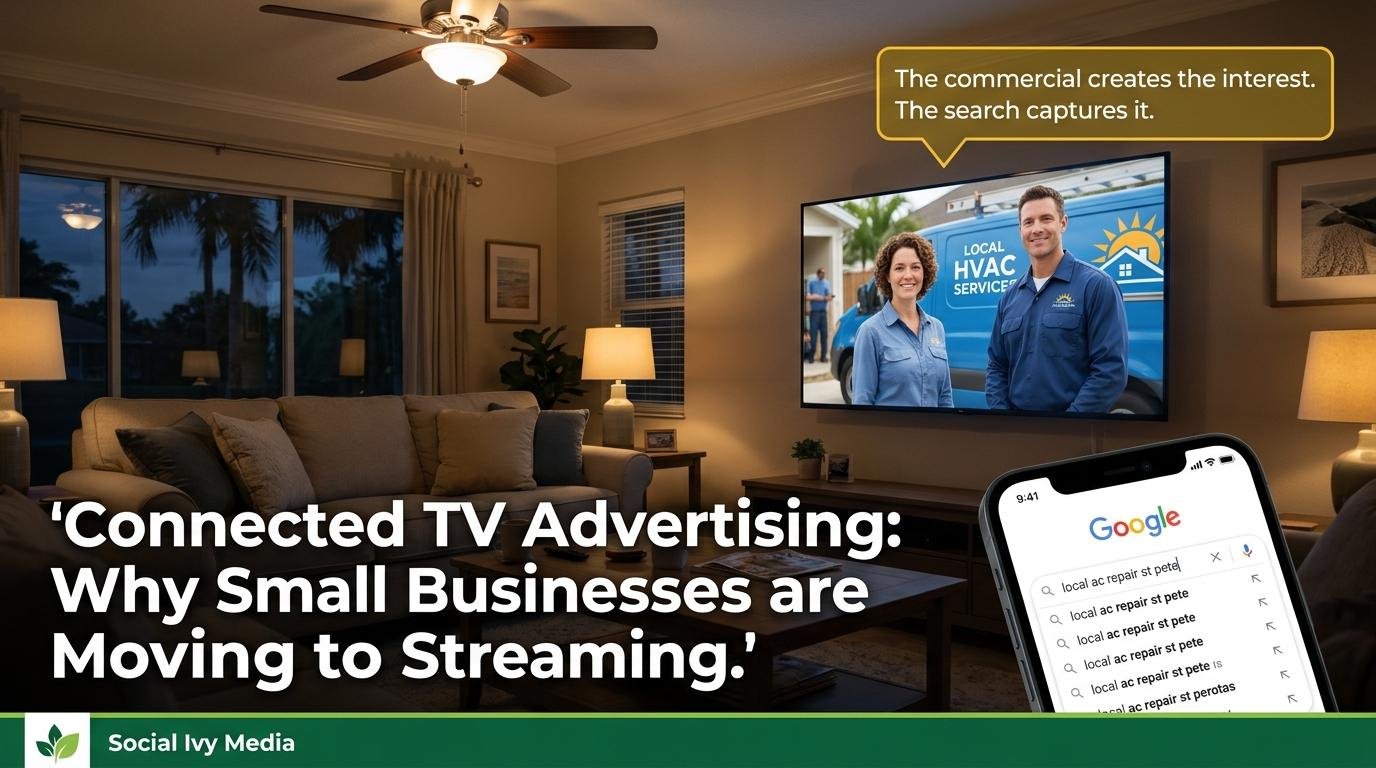

Ask most small-business owners in Tampa Bay where their ad budget goes and you’ll hear the same answer: Google and Facebook. That made sense for a long time. Search captured people who were ready to buy, and social put you in front of everyone else.
In 2026 that two-channel playbook is showing its age. Costs on the biggest ad platforms have crept up as more businesses bid for the same clicks. Organic reach on social keeps shrinking unless you pay to boost it. And audiences have developed a thick skin for ads in a scroll. A sponsored post gets about as much attention as a billboard seen from a moving car.
That’s digital fatigue: the point where adding more budget to the same crowded channels produces less each month. It’s also why connected TV advertising has moved from something big brands did to something small businesses are seriously evaluating.
Connected TV, or CTV, means video ads shown on internet-connected televisions: smart TVs, streaming sticks, game consoles, and the streaming apps people watch on them. Your 15- or 30-second spot runs during a show, often on the biggest screen in the house, in front of households you chose by geography, interests, or demographics. Compared with traditional broadcast TV, the buying is more flexible, the targeting is more precise, and the minimum spend is far lower.
The stakes are straightforward. Your customers’ viewing time has been shifting from cable to streaming for years. If the only places your brand appears are search results and social feeds, you’re competing in the noisiest rooms while a quieter, high-attention screen goes to whoever shows up first in your market.
But CTV isn’t automatically a smart buy. Plenty of businesses try it, see a report full of impressions, and can’t tell whether anything happened. The difference between those two outcomes is strategy, and the place to start is understanding why most first attempts fall short.
Why Most Small Businesses Get Streaming Ads Wrong
The most common reason CTV underperforms has nothing to do with the channel. It’s that the business treats it like a standalone purchase, a box to check, instead of one part of a system.
Here’s how that plays out.
Buying TV like it’s search. Search ads capture people actively looking for a solution. CTV reaches people relaxing on the couch who weren’t looking for anything. Expecting a streaming ad to produce phone calls the same way a Google ad does sets up a false comparison, and many businesses cancel a campaign that was doing its job simply because they judged it by the wrong standard.
Targeting too wide. “Everyone in Tampa Bay” is not a target. A pool service in Pinellas County gains nothing from impressions in Pasco households it can’t serve. Tight geography and a defined household profile matter more than raw reach.
Weak creative. A rushed spot with no clear message, no local relevance, and no next step wastes the one thing CTV does better than any other digital channel: hold attention. Viewers usually can’t skip, so a confusing or forgettable ad is a missed opportunity you paid full price for.
Nowhere to land. A viewer who remembers your ad will typically search for you or type your web address later. If your Google Business Profile is thin, your site is slow, or your homepage doesn’t repeat the offer from the commercial, that interest evaporates.
No measurement plan. If tracking isn’t set up before launch, there’s no way to connect a streaming impression to a website visit, a search, or a lead. The report shows how many people saw the ad and how many watched it to the end, and nothing about whether it made you money.
[STRATEGIST WARNING] The two costliest CTV mistakes we see: launching streaming ads with no plan to capture the demand they create, and judging the campaign by impressions and completion rates alone. The first means your TV spend warms up prospects who then click a competitor’s search ad. The second lets a campaign look healthy on paper while you can’t point to a single lead, so the budget gets cut or, worse, renewed blindly.
None of this means CTV doesn’t work for small businesses. It means it works as part of a connected plan, not as a lone experiment.
How Connected TV Advertising Works for a Local Business
A streaming campaign that produces results has five working parts. Each one depends on the others.
Define the audience and the geography first
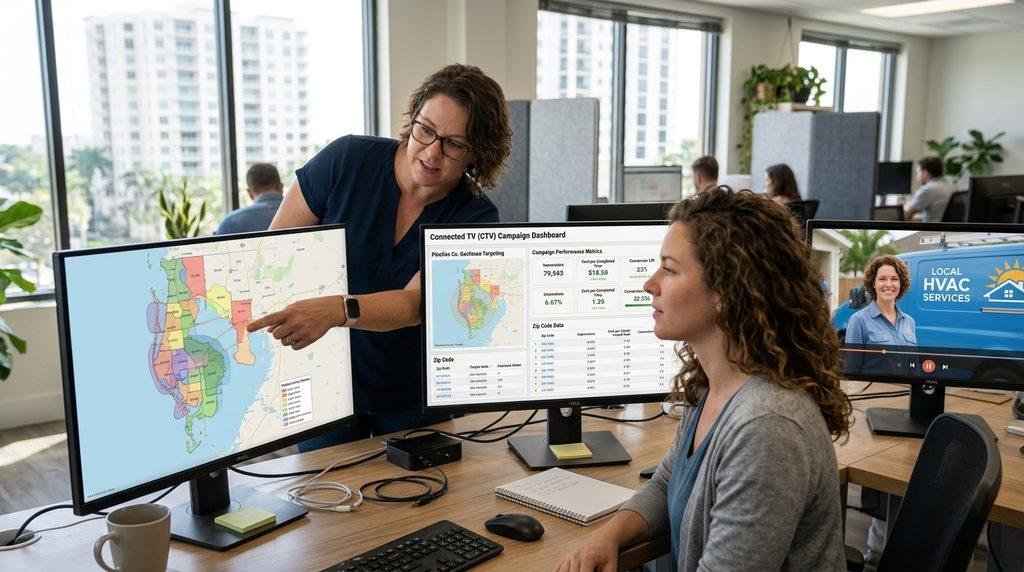
Start with who you can actually serve and profit from. For most local businesses that means a defined service radius or set of zip codes, plus a household profile: homeowners, families, specific age ranges, or interest signals tied to your offer. CTV platforms can target at the household level, which makes it possible to put a commercial in front of homes in Clearwater and St. Pete without paying for viewers in Lakeland.
For owners researching the kind of connected TV advertising Bay area businesses can afford, geography is the first budget lever. A tighter footprint concentrates frequency, so the same households see your ad enough times to remember it.
Build creative that earns the full 30 seconds
Strong CTV creative does three things quickly: names the problem the viewer recognizes, shows who you are (real people, real location, real work), and gives one simple next step. That step should be memorable without a pen: your business name, a short web address, or “search [your business name].” Local cues such as a recognizable neighborhood, the Gulf, or a familiar street help the ad feel like it belongs to the viewer’s community rather than to a national brand.
Production no longer requires a broadcast budget, but quality still matters. A clear, well-lit, honest spot with your own team will usually outperform a slick generic one.
Pair streaming reach with search and social capture
This is the piece most businesses miss. CTV creates awareness and interest; something else has to catch it. When a viewer searches your name or service after seeing your ad, you want to be there with a strong result and, often, a search ad. Well-managed pay-per-click traffic and retargeting are what turn that television moment into a click and then a lead. Search Engine Journal covers paid search strategy closely, and a recurring theme there is that branded-search campaigns are among the most efficient ways to capture demand created elsewhere.
The same goes for social. Paid social media marketing that retargets streaming-exposed households, or that runs the same message in shorter form, reinforces recall and gives viewers a second, easier place to act. Google ads management and social retargeting are what turn CTV from a brand expense into the top of a measurable pipeline.
Make the landing destination match the commercial
Every campaign should have a dedicated landing page that repeats the offer from the ad, loads quickly on a phone, shows proof (reviews, real photos, credentials), and makes calling or booking obvious. A homepage built for everyone converts no one in particular. Professional website design and development is what keeps the handoff from TV to web from breaking.
Television used to be the channel you couldn’t measure, and digital was the channel nobody remembered. Connected TV, done right, gives a small business both: the attention of a commercial and the accountability of a click. The advantage goes to whoever connects the screen to the search bar to the sales call.
Measure what the campaign actually changed
Before launch, agree on the metrics that define success. For most local businesses those include:
- Website visits from exposed households (where the platform supports it)
- Lift in branded searches for your business name
- Leads and calls during and after the flight, compared with a baseline
- Cost per lead across CTV plus the search and social campaigns supporting it
- Completion rate, as a creative-quality check, not a success metric
Industry groups such as the ANA have treated CTV measurement and transparency as a priority topic precisely because impression counts alone don’t tell an advertiser what they bought. Plan for that from day one, and be skeptical of any report that can’t connect exposure to some kind of business outcome.
When this is all in place, connected TV campaigns built for local reach stop being a leap of faith and become a channel you can test, adjust, and scale on evidence.
The Real Cost of Staying on “Good Enough” Channels
Sticking with only search and social feels safe because the numbers are familiar. The cost is what that safety leaves on the table.
When every competitor in your category bids on the same keywords, your cost per click rises and your share of the conversation stays flat. Buying more ppc traffic in a saturated market can mean paying more each year to stand still. Meanwhile, the households you most want to reach are spending a growing share of their evenings with streaming apps, where few local competitors have shown up yet.
The broader money trail points the same way. Statista has tracked strong growth in connected TV and streaming ad spending over recent years as advertisers follow viewers away from cable. That shift is driven largely by national brands, which is exactly why early local adopters can still find attention on streaming that is harder to win in crowded feeds.
The table below compares two approaches. The figures are illustrative estimates, not measured client results. Assumptions: a local service business with a modest monthly budget split across channels and an average job value in the low thousands.
| 1 | Typical Result | Cost of Inaction | Time to ROI |
|---|---|---|---|
| Amateur / DIY Approach | A one-off CTV buy with broad targeting, generic creative, no landing page, and reporting limited to impressions | Estimated: a full test budget spent with no way to tie exposure to leads, plus prospects who search later and find a competitor’s ad | Often never clear, because tracking and search capture were not in place |
| Social Ivy Approach | Tight geography, local creative, a dedicated landing page, search and social retargeting, and reporting on visits, branded search, and leads | Estimated: less wasted spend, because underperforming audiences and creative are cut early and budget follows what moves leads | Depends on industry, budget, competition, and implementation; CTV usually supports results over several flights rather than overnight |
A simple way to frame it: if one new customer is worth $2,000 to you and a coordinated streaming-plus-search campaign produces even a few extra qualified leads a month, the economics can look very different from a TV buy judged in isolation. That’s an illustration, not a forecast. Your close rate, job value, and market will set the real numbers.
The KPIs that keep everyone honest
Whether you run CTV yourself, through a self-serve platform, or with an agency, ask for these:
- Cost per qualified lead across the whole campaign, not just the TV line item.
- Branded search lift during flights versus quiet periods.
- Exposed-household site visits, where the platform can report them.
- Lead-to-customer rate, so you know whether the leads are real.
- Social media advertising ROI for retargeting that runs alongside the streaming ads, judged by leads and revenue rather than likes.
A campaign that improves those numbers is working. A campaign that only grows impressions is just expensive awareness. Connecting each channel into a single sales and marketing funnel is what makes that distinction visible.
Why Social Ivy Media
We’re based in St. Petersburg, and most of the businesses we work with compete for customers across Pinellas County and greater Tampa Bay. That local focus shapes how we plan streaming campaigns. Knowing where your customers actually live, which neighborhoods are worth the frequency, and how seasonal patterns like hurricane prep and winter visitors shift demand changes both the targeting and the timing.
Our work runs on an AGILE marketing approach. For CTV, that means we don’t lock you into a long, expensive flight built on guesses. We launch focused tests with a clear hypothesis, review real lead and search data, and adjust audiences, creative, and budget in short cycles. What works gets more budget. What doesn’t gets cut before it becomes costly.
The agency is led by CEO Dion De Lauder, and the principle behind our work is consistent: rankings create visibility, authority creates trust, and strategy creates conversions. Streaming TV is one of the strongest visibility tools available to a local business today, but only when it’s tied to the trust and conversion pieces that come after it.
That’s why cross-channel capability matters here more than almost anywhere else. A CTV campaign depends on search ads to capture demand, on social to reinforce the message, on a website built to convert, and on a funnel that tracks the whole path. Because our team handles SEO, paid search, paid social, website design, and funnel strategy together, we can plan the commercial and the capture system as one project instead of handing you off between vendors who never compare notes.
The Journey: What Working Together Looks Like
Audit
What happens: We review your current ad accounts, website and landing pages, Google Business Profile, tracking setup, and how leads are handled. What to expect: A clear view of whether you’re ready for CTV now or need to fix the capture side first. What we need from you: Access to ad accounts and analytics, your service area, average job value, and close rate. What we handle: The full review and a plain-language readiness report.
Strategy
What happens: We define target households and geography, the offer, creative direction, channel roles (CTV, search, social), budget split, and success metrics. What to expect: A focused test plan, not a year-long commitment. What we need from you: Input on your best customers, seasonality, capacity to handle new leads, and approval of the offer. What we handle: Media planning, measurement design, and the creative brief.
Launch
What happens: We produce or refine the spot, build the landing page, set up tracking, and launch streaming alongside supporting search and social campaigns. What to expect: Early delivery and engagement data first; lead trends take longer to read. What we need from you: Timely approvals, participation in filming if we use your team, and prompt follow-up on every lead. What we handle: Production coordination, campaign setup, and daily management.
Optimize and Scale
What happens: We review performance in regular cycles, refine audiences and creative, shift budget toward what produces leads, and expand geography when results justify it. What to expect: Reporting focused on leads, cost per lead, branded search, and site visits. What we need from you: Feedback on lead quality and closed jobs. What we handle: Testing, optimization, and scaling recommendations.
Outcomes depend on your industry, budget, competition, and implementation. We won’t promise fixed timelines, rankings, or revenue figures, and you should be wary of anyone who does.
The Fix Starts with a Strategy Session
The central point of this guide is simple: small businesses aren’t moving to streaming because it’s new. They’re moving because their customers already have, and because search and social alone are getting more crowded and more expensive. Connected TV advertising gives a local business a high-attention screen at a price that was out of reach a few years ago. But it pays off only when the commercial, the search capture, the landing page, and the tracking work as one system.
That’s why we don’t treat the first conversation as a media order or a sales pitch. We treat it as a growth diagnostic. Before you spend anything on streaming, it’s worth knowing whether your current funnel can catch the demand TV creates, which geography and audience make sense for your margins, and what a fair test budget looks like for your market.
Here’s how to take the next step, depending on how you prefer to work:
- Book a strategy session. Schedule a growth diagnostic with our team at [INSERT STRATEGY SESSION URL]. Bring your current ad numbers if you have them.
- Talk to us first. If you’d rather ask a few questions before committing time, call [INSERT PHONE NUMBER] or email [INSERT EMAIL ADDRESS].
- Learn more on your own terms. If you’re still researching, see how our streaming TV advertising service for local businesses is structured.
Whichever route you choose, the goal is the same: meet your customers where they’re watching, and make sure every impression has somewhere to go.
About the Author
Social Ivy Media — Growth Strategy Team St. Petersburg, FL | Serving Tampa Bay Since [Year]
Social Ivy Media is a full-service digital marketing agency based in St. Petersburg, Florida, led by CEO Dion De Lauder. We help local and regional businesses grow through integrated SEO, paid media, social, website design, and funnel strategy — built to convert, not just to look good.
🌐 socialivymedia.com 📍 St. Petersburg, FL