
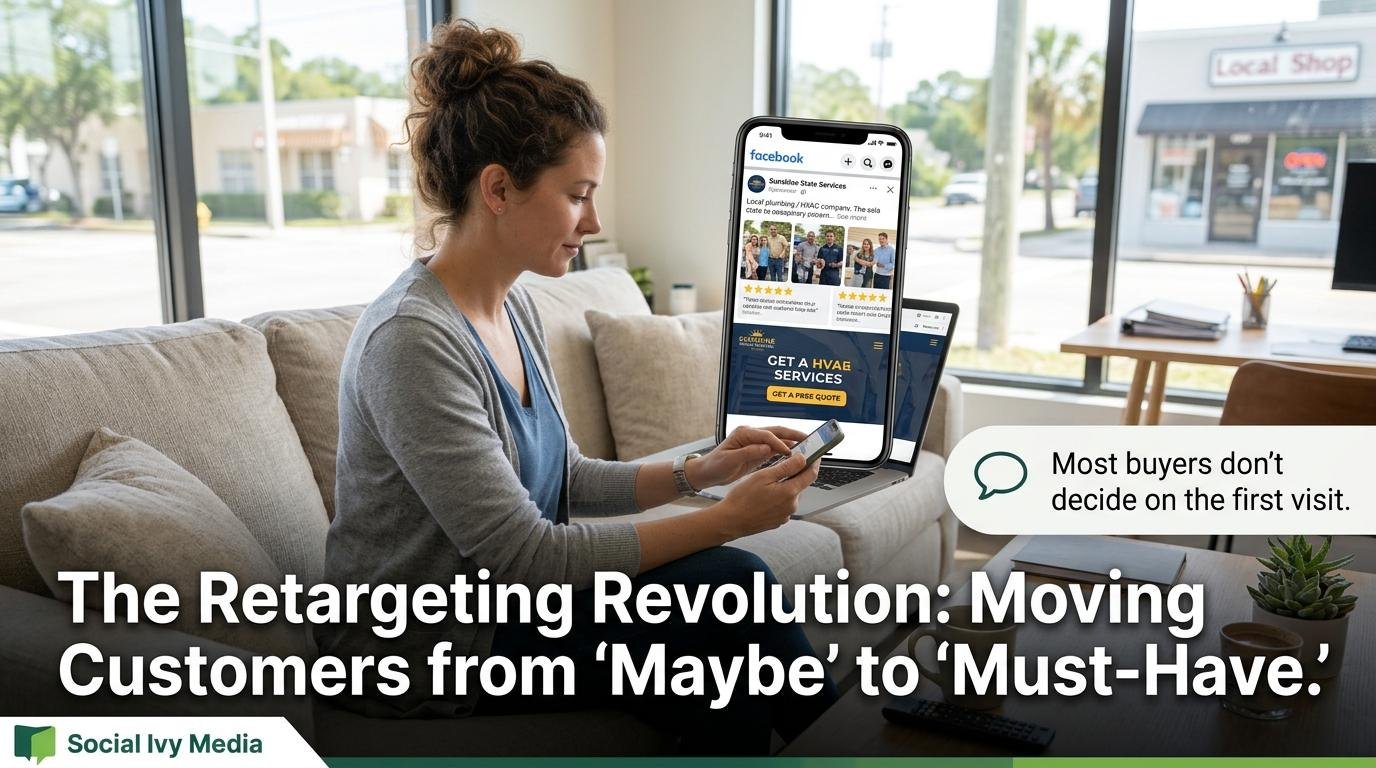

Think about the last time you hired a contractor, chose a dentist, or bought something expensive online. You probably didn’t decide on the first visit. You looked around, compared options, got distracted, and came back later, maybe days later, to the business that stayed on your mind.
Your customers do the same thing. Most people who visit a small-business website for the first time leave without calling, booking, or filling out a form. That’s not a failure of the website. It’s how considered purchases work. The failure happens when the business that paid to bring that visitor in does nothing to stay in the conversation afterward.
That’s where a retargeting strategy comes in. Retargeting, sometimes called remarketing, shows ads to people who have already interacted with your business: visited your site, watched your video, engaged with your social posts, or appear on your customer list. Instead of paying to introduce yourself to strangers again and again, you spend part of your budget on people who already know you exist and showed some interest.
It sounds like an obvious win, and in principle it is. In practice, retargeting is where a lot of ad budgets go to waste. This is digital fatigue in its most personal form: the same banner chasing someone across the internet for weeks, the ad for a service they already bought, the generic “Still thinking about it?” message that reminds them why they left. Buyers notice, and they get annoyed.
At the same time, the rules have changed. Browser privacy protections, mobile tracking restrictions, and ad blockers have made it harder to build large, accurate audiences from website pixels alone. Retargeting still works, but only for businesses that treat it as a deliberate follow-up system rather than a switch they flipped once in an ad account.
The difference between those two approaches is substantial, and it starts with understanding why so much retargeting misses.

Why Most Retargeting Follows the Wrong People with the Wrong Message
The core mistake is treating every past visitor the same. Most accounts have one audience, “all website visitors, last 30 days,” and one ad shown to all of them. That setup ignores the single most valuable thing retargeting knows: what each person actually did.
Here’s how the gap shows up.
No intent segmentation. Someone who read one blog post for two minutes and someone who spent five minutes on your pricing page and started a booking form are at completely different stages. Showing them the same ad wastes the opportunity with both.
One message for every stage. A person who’s just discovered you needs reassurance: who are you, why trust you? A person comparing quotes needs proof: reviews, guarantees, credentials, real work. A person who almost booked needs a reason to finish: a clear offer, a simple next step, an answer to the objection that stopped them. One generic ad can’t do all three.
No exclusions. Customers who already bought keep seeing ads for the thing they bought. Job applicants who visited your careers page see service ads. Every one of those impressions is wasted spend, and many of them irritate people you’d rather keep happy.
No frequency control. Without caps, a small audience can see the same ad dozens of times in a week. Past a point, more impressions don’t build familiarity; they build resentment.
Retargeting a leaky page. If the website didn’t convert the visitor the first time because it was slow, confusing, or lacked proof, sending them back to the same page rarely changes the outcome. You just pay twice for the same “no.”
[STRATEGIST WARNING] The two costliest retargeting mistakes we see: lumping every visitor into one audience with one ad, and failing to exclude people who already converted. The first spends premium retargeting budget on low-intent browsers while high-intent prospects get a generic message. The second pays to show ads to existing customers, and it can make your brand look careless right when you want it to look attentive.
None of this means retargeting is overrated. It means it has to be designed around the buyer’s path, not just switched on.
Building a Retargeting Strategy That Moves Buyers Forward
A strong retargeting program has five working parts. Each one depends on the one before it.
Build audiences around behavior, not just visits
Start by deciding which actions signal meaningful interest, then build separate audiences for each. Typical tiers for a local service business might be:
- Visitors who viewed a service page or pricing page
- Visitors who started but didn’t finish a booking or quote form
- People who watched most of a video ad or engaged with a social post
- Past customers, uploaded from your own customer list
- General blog readers and lower-intent visitors
Set membership windows to match how long your buyers actually take to decide. A same-week emergency service might use a short window. A kitchen remodel or medical procedure might justify a longer one.
Match the message to the stage
Each audience gets its own creative. Lower-intent visitors see trust-building content: who you are, a short team video, what makes your process different. Service-page visitors see proof: reviews, before-and-after photos, credentials, and answers to common questions. Form abandoners see a direct, low-friction next step: “Book a free estimate in two minutes,” or “Questions? Talk to a real person today.”
This sequencing is what separates a real retargeting strategy from a reminder banner. Each ad should move the person one step closer, not just repeat that you exist.
Run it across the channels your buyers actually use
Retargeting works best when it follows people to where they spend time, without overwhelming them in any one place. Search remarketing lets you bid more aggressively when a past visitor searches again. Display and video placements keep you visible while they browse. Pay-per-click traffic and remarketing on search often deserve the most budget, because those people are actively looking again.
Social platforms are just as important. Paid social media marketing lets you reach past visitors and engaged followers with short video, reviews, and offers in the feeds they check daily. Strong social media management and marketing also builds the engagement audiences you can retarget later, so organic content and paid follow-up feed each other. The best social media advertising strategies treat retargeting as the second half of every campaign, not an afterthought.
Lean on first-party data
As tracking gets harder, the data you own becomes more valuable. Customer email lists, phone lists, and CRM records can be uploaded (with proper consent and in line with each platform’s policies) to build matched audiences, exclude existing customers, or find new people who resemble your best ones. Search Engine Journal has covered the shift toward first-party data extensively as privacy changes have reshaped tracking, and the practical lesson for local businesses is clear: collect permissioned contact information, keep it organized, and use it.
Update your privacy policy so it accurately describes how you use cookies, pixels, and customer data. Trust is the point of retargeting; don’t undercut it.
Catch returning visitors when they come back
Retargeting brings people back to your site, often when they’re closer to deciding. That’s the moment to make the next step as easy as possible. Live chat with website visitors gives a returning prospect a way to ask the one question still holding them back, without picking up the phone. Live chat lead conversion is especially useful for retargeted traffic, because these visitors already know who you are and often just need a fast, human answer.
Retargeting isn’t about following people around the internet; it’s about continuing a conversation they already started. Businesses that match the message to where each buyer is, and make the next step effortless, stop paying for the same visitor twice and start turning “maybe” into “yes.”
Set guardrails
Cap frequency so each person sees your ads a reasonable number of times per week. Exclude recent converters, employees, and job seekers. Refresh creative regularly so returning prospects don’t see the same tired ad. And use social media marketing automation carefully: automated sequences and rules save time, but someone should still review what’s running and who’s seeing it.
The Real Cost of “Good Enough” Retargeting
“Good enough” retargeting usually means one audience, one ad, and a report showing a low cost per click. It looks efficient. Its real cost is the high-intent prospects it fails to convert and the budget it spends on people who were never going to buy.
Consider the economics. Every visitor you bring in through ppc traffic, social ads, or SEO costs money or effort to acquire. If most of them leave and you do nothing, that acquisition cost is spread across only the small share who converted on the first visit. A disciplined retargeting program spreads it across more customers, because some of those first-time visitors come back and buy. That’s what makes retargeting one of the highest-leverage line items in a paid media budget, when it’s done well.
The broader market reinforces the point. Statista has tracked continued growth in digital advertising spend, which in practice means more advertisers competing for the same new audiences. Re-engaging people who already showed interest is one of the few ways to get more from the traffic you’ve already paid for, instead of buying ever more expensive new traffic.
The comparison below uses illustrative estimates, not measured client results. Assumptions: a local service business with moderate site traffic, a modest monthly ad budget, and an average job value in the low thousands.
| Scenario | Typical Result | Cost of Inaction | Time to ROI |
|---|---|---|---|
| Amateur / DIY Approach | One “all visitors” audience, one generic ad, no exclusions or frequency caps, reporting on clicks | Estimated: budget spent on low-intent visitors and existing customers, high-intent prospects lost to competitors, and some brand fatigue | Often unclear, because retargeting results aren’t separated from other campaigns |
| Social Ivy Approach | Intent-based audiences, stage-specific creative, cross-channel delivery, exclusions, frequency caps, and lead tracking by audience | Estimated: less wasted spend and more conversions from traffic already acquired | Depends on industry, budget, competition, and implementation; results are typically easier to read once there’s enough traffic to build meaningful audiences |
A simple illustration, not a forecast: if your site converts 3% of first-time visitors and well-segmented retargeting brings back enough of the rest to convert another 1% to 2% of the original traffic, you’ve increased leads by a third to two-thirds without buying a single new visitor. Your actual numbers depend on traffic, offer, and market.
The KPIs that tell you the truth
When you review retargeting performance, look past click-through rates. Ask for:
- Conversions by audience segment: which tiers actually produce leads.
- Cost per lead from retargeting versus prospecting campaigns.
- Frequency per user: confirm people aren’t being overexposed.
- Assisted conversions: how often retargeting touched a lead that converted through another channel.
- Social media advertising ROI on retargeting campaigns, judged by leads and revenue, not engagement.
Measurement has limits here. Privacy changes mean some conversions won’t be tracked perfectly, and attribution models differ by platform. The ANA has made privacy and responsible data use a central industry topic for good reason. Track what you can reliably measure, compare against a baseline, and stay skeptical of platform reports that claim credit for every sale.
Why Social Ivy Media
We’re based in St. Petersburg, and most of the businesses we work with compete for customers across Pinellas County and greater Tampa Bay. Local buying cycles shape how we build retargeting. A homeowner comparing roofers after a storm decides on a very different timeline than a family choosing a pediatric dentist, and seasonal shifts like summer heat and winter residents change who’s in the market and how long they take to decide. We set audience windows, messaging, and budgets around those realities.
Our work runs on an AGILE marketing approach. For retargeting, that means we launch with a clear hypothesis about which audiences and messages matter most, review real lead data in short cycles, and adjust. Underperforming segments get cut or reworked quickly. Strong segments get more budget.
The agency is led by CEO Dion De Lauder, and the principle behind our work is consistent: rankings create visibility, authority creates trust, and strategy creates conversions. Retargeting sits squarely in the trust-and-conversion part of that chain. It’s how a business that earned someone’s attention once earns their decision.
That’s also why retargeting works best inside a cross-channel plan. Its audiences come from SEO, paid search, social, and video. Its effectiveness depends on the website, the offer, and how fast leads get a response. Because our team handles SEO, paid media, social, website design, and funnel strategy together, we can design retargeting as part of the whole buyer path instead of bolting it onto one ad account.
The Journey: What Working Together Looks Like
Audit
What happens: We review your tracking setup, current audiences, ad accounts, website conversion paths, customer data, and privacy disclosures. What to expect: A clear picture of how many potential customers you’re losing after the first visit and where retargeting could help most. What we need from you: Access to analytics and ad accounts, any customer lists you maintain, and your average job value and sales cycle. What we handle: The full review and a prioritized findings report.
Strategy
What happens: We define audience tiers, membership windows, messaging by stage, channels, frequency caps, exclusions, and success metrics. What to expect: A focused plan built around how your buyers actually decide. What we need from you: Input on common objections, your strongest proof points, and any offers you’re willing to make. What we handle: The audience map, creative briefs, and measurement plan.
Launch
What happens: We install or clean up tracking, build audiences, produce stage-specific creative, and launch campaigns across search, social, and display, with live chat or other response tools where they fit. What to expect: Audiences take time to fill, so early reporting focuses on delivery and engagement before lead trends are clear. What we need from you: Timely approvals, an up-to-date customer list for exclusions, and fast follow-up on new leads. What we handle: Setup, creative production, and day-to-day management.
Optimize and Scale
What happens: We review performance by segment in regular cycles, refresh creative, adjust windows and budgets, and expand what works. What to expect: Reporting focused on leads, cost per lead, and conversions by audience. What we need from you: Feedback on lead quality and closed jobs. What we handle: Testing, optimization, and scaling recommendations.
Outcomes depend on your industry, budget, competition, and implementation. We won’t promise fixed timelines, rankings, or revenue figures, and you should be wary of anyone who does.
The Fix Starts with a Strategy Session
The central point of this guide is simple: most of your future customers have already visited your website, seen your ad, or followed your page. They just haven’t decided yet. A thoughtful retargeting strategy keeps you in that decision with the right message at the right moment, while a careless one simply follows people around until they tune you out.
That’s why we don’t treat the first conversation as a request to “turn on retargeting” or as a sales pitch. We treat it as a growth diagnostic. Before you spend more bringing new visitors in, it’s worth knowing how many you’re already losing, why they leave, and what it would take to bring the right ones back.
Here’s how to take the next step, depending on how you prefer to work:
- Book a strategy session. Schedule a growth diagnostic with our team at [INSERT STRATEGY SESSION URL]. Bring your analytics and ad account access if you have them.
- Talk to us first. If you’d rather ask a few questions before committing time, call [INSERT PHONE NUMBER] or email [INSERT EMAIL ADDRESS].
- Learn more on your own terms. If you’re still researching, see how retargeting fits into our sales and marketing funnel design process.
Whichever route you choose, the goal is the same: stop paying twice for the same visitor, and give every “maybe” a clear path to “yes.”
About the Author
Social Ivy Media — Growth Strategy Team St. Petersburg, FL | Serving Tampa Bay Since [Year]
Social Ivy Media is a full-service digital marketing agency based in St. Petersburg, Florida, led by CEO Dion De Lauder. We help local and regional businesses grow through integrated SEO, paid media, social, website design, and funnel strategy — built to convert, not just to look good.
🌐 socialivymedia.com 📍 St. Petersburg, FL