
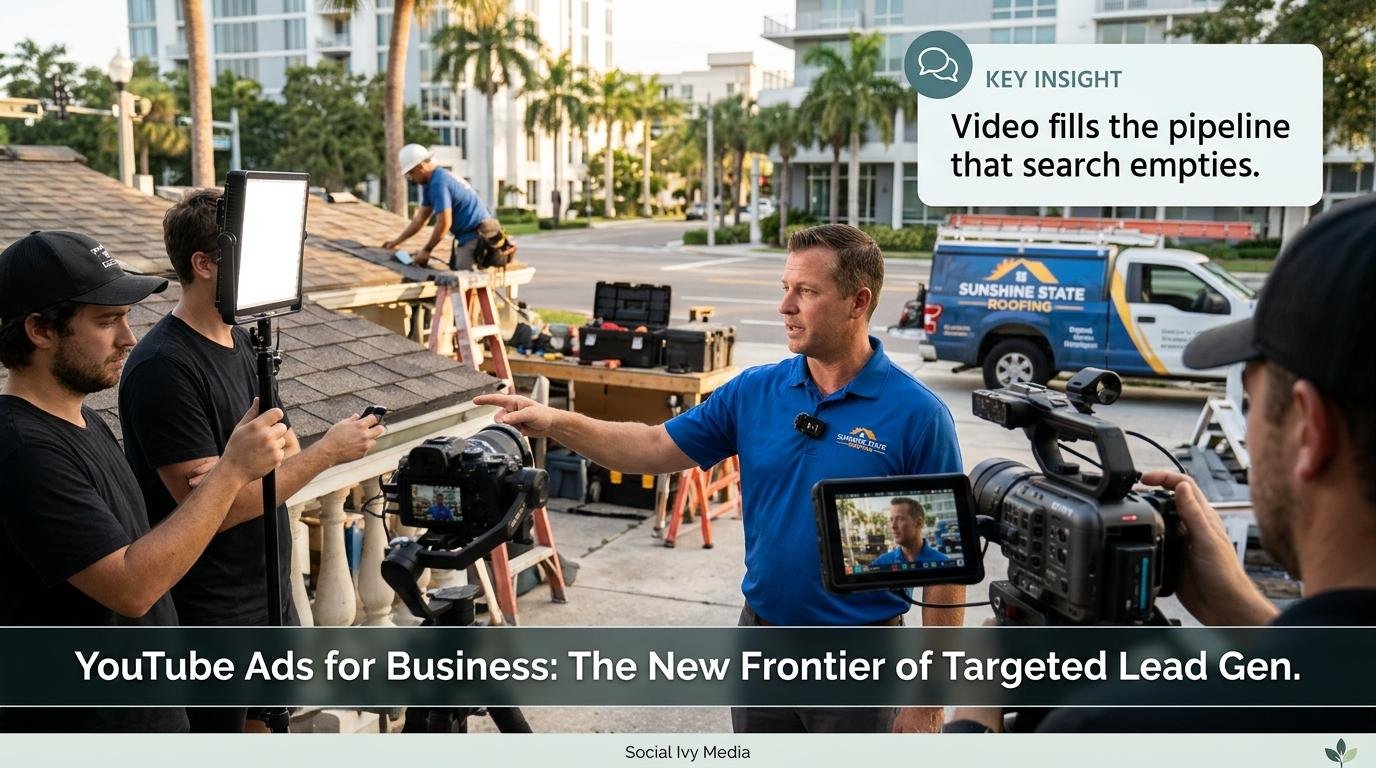

Why Text Ads Alone Are Running Out of Room
For most local businesses, paid advertising means two things: search ads and social ads. Both still work. But both are getting crowded, and in competitive categories the cost of standing out keeps rising. Search pages are packed with ads and map listings. Social feeds are full of sponsored posts that people scroll past without a second look.
That’s digital fatigue, and it shows up in your numbers as higher costs per click, lower engagement, and leads that cost more every quarter. Meanwhile, one of the largest platforms on the internet often goes untouched by small businesses: YouTube.
That gap is why YouTube ads for business deserve a serious look in 2026. YouTube isn’t just a place for entertainment. People use it to research purchases, learn how things work, compare options, and solve problems. A homeowner wondering whether their AC unit needs replacing, a patient researching a procedure, or a business owner comparing accounting software may well watch a video about it before ever filling out a form. And more of that viewing now happens on television screens, through smart TVs and streaming devices, as well as on phones.
For a local business, that creates an opportunity that didn’t really exist a decade ago: putting a short, targeted video in front of people in your service area who have shown signs of needing what you sell, at a cost that doesn’t require a TV-sized budget.
But YouTube is also an easy place to waste money. Many businesses try it once, run a generic video to a broad audience, see thousands of views and no leads, and conclude it doesn’t work. Usually the platform wasn’t the problem. The setup was. Understanding why first attempts fail is the fastest way to avoid repeating them.
Why Most First YouTube Campaigns Disappoint
YouTube advertising sits between two worlds. It has the reach and storytelling of television and the targeting and measurement of search. Businesses that treat it purely like either one tend to get it wrong.
Here’s where it usually breaks down.
Treating views as results. Views are cheap and plentiful on YouTube. A campaign can rack up a big view count while producing nothing a business can deposit. If the goal and the reporting are built around views, the campaign will optimize toward the cheapest possible attention, not the most valuable.
Targeting too broadly. “Adults in Tampa Bay” is not a strategy. Without specific audience signals, your ad competes for attention with every other advertiser and reaches many people who will never need your service.
Repurposing the wrong video. A polished brand video made for your homepage, or a TV spot that takes 15 seconds to reveal what you do, rarely works as a skippable ad. Viewers decide in seconds whether to keep watching. If the opening doesn’t hook them, the rest doesn’t matter.
No clear next step. Many business videos end with a logo and nothing else. A viewer who’s interested needs to know exactly what to do next: visit a page, call, or search your name.
Running video in isolation. Most people who see a YouTube ad won’t click it immediately. They’ll remember it, and later they’ll search for you or come back through another channel. If you’re not visible in search and not remarketing to people who watched, that interest goes to whoever is.
[STRATEGIST WARNING] The two most expensive YouTube mistakes we see: optimizing campaigns for views instead of leads, and running video without search or remarketing to capture the interest it creates. The first produces impressive-looking reports while the phone stays quiet. The second means your video does the hard work of building interest, and then a competitor’s search ad collects the customer.
None of these mean YouTube is wrong for local businesses. They mean it needs to be planned as part of a lead generation system.
How to Make YouTube Ads for Business Generate Real Leads
A YouTube campaign that produces leads has five connected parts. Each one supports the others.
Use targeting that reflects intent
YouTube ads are bought through Google Ads, and that’s their biggest advantage. Beyond basic demographics and geography, advertisers can build audiences from signals such as the topics people watch, the interests and purchase research Google associates with them, and, through custom segments, terms people have recently searched on Google. For a local business, that means a video can reach people in your service area who recently searched for the kind of problem you solve, rather than anyone who happens to be watching.
You can also target your own data: people who visited your website, watched your previous videos, or appear on your customer list (with appropriate consent). Layered together with tight geography, these signals turn YouTube from broad awareness into something much closer to targeted prospecting.
This is where experienced google ads management matters. The targeting options are powerful but easy to misconfigure, and small setup choices have a large effect on who actually sees your ad.
Choose formats that match the goal
YouTube offers several ad formats, and each does a different job:
- Skippable in-stream ads play before or during videos and can be skipped after a few seconds. They’re well suited to lead generation because you generally pay based on meaningful viewing or interaction, not every impression.
- Non-skippable and bumper ads are short spots that viewers can’t skip. They’re best for reinforcing a message with people who already know you.
- In-feed and Shorts ads appear in search results, recommendations, and the short-form video feed, reaching people who are actively browsing.
Google also offers campaign types built specifically for conversions and lead generation across YouTube and its other surfaces. These names and options change periodically, so the setup should be reviewed against what’s currently available rather than copied from an old guide.
Build creative for the first five seconds
The opening of a skippable ad does most of the work. Lead with the viewer’s problem, not your logo. Show a real person, a real place, a real result. Say who it’s for within the first few seconds so the right people keep watching and the wrong ones skip early, which costs you less.
Keep it simple. One problem, one solution, one next step. Shoot vertical versions for Shorts and horizontal versions for standard placements. Authentic, well-lit video of your own team often outperforms an expensive production that feels like every other commercial.
Capture the interest video creates
Video is often where a buyer first meets you. Search is often where they come back to act. Make sure that when someone searches your business name or service after seeing your ad, you appear with a strong result and a relevant search ad. Disciplined pay-per-click traffic management is what keeps that returning ppc traffic from slipping to a competitor.
Then remarket. People who watched most of your video are some of the warmest prospects you’ll find. Follow up with a different message, proof such as reviews and project photos, or a direct offer, and send them to a landing page built specifically for that offer. That landing page should be part of a structured sales and marketing funnel design, so every view has a path toward a lead.
Treat the TV screen as its own placement
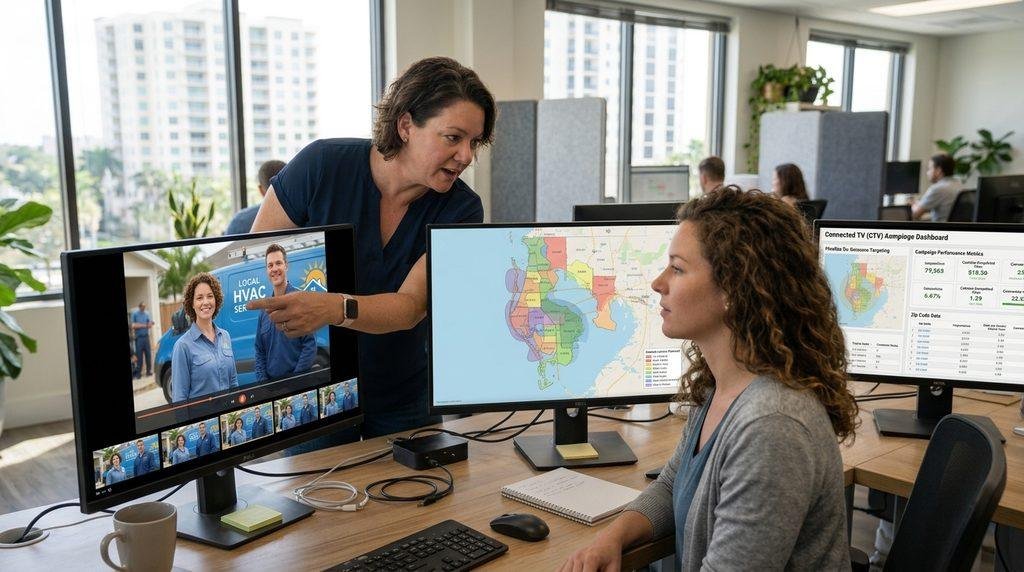
A growing share of YouTube viewing happens on televisions through smart TVs and streaming devices. That makes YouTube a natural companion to streaming TV campaigns, and for some local businesses, a practical entry point into the big screen. For owners already exploring the kind of connected TV advertising Bay area businesses use to reach households, YouTube and connected TV advertising can share creative, audiences, and messaging, while each covers viewing the other misses.
Keep in mind that someone watching on a TV can’t click. Your call to action should work without a click: your business name, a memorable web address, or “search for us.”
Video doesn’t replace search; it fills the pipeline that search later empties. Businesses that use YouTube to reach the right households, then capture that interest with search and remarketing, stop competing only for buyers who are already looking and start shaping who those buyers choose.
The Real Cost of “Good Enough” Video Advertising
“Good enough” YouTube advertising usually means one video, a broad audience, and a report full of views. It feels like progress because the numbers are big. Its real cost is the budget spent on people who will never buy, and the interested viewers who were never followed up with.
There’s also the cost of not showing up at all. Viewing habits have steadily shifted toward online video, and Statista has tracked continued growth in both online video audiences and digital video advertising spend. That shift means your customers are spending more of their attention in places where many local competitors aren’t advertising yet. Early, well-run campaigns can earn attention that’s harder to win in crowded search and social feeds.
Here’s a simple illustration, not a forecast. Suppose a business spends $1,500 a month on YouTube with broad targeting and a generic video, and the campaign produces plenty of views but only a lead or two. Shift the same budget to tight geography, intent-based audiences, a problem-first video, and remarketing that sends warm viewers to a dedicated landing page, and even a few additional qualified leads a month can change the return entirely. Your actual results depend on your market, offer, and creative. That’s the difference between YouTube ads for business that look busy and ones that pay for themselves.
The comparison below uses illustrative estimates, not measured client results. Assumptions: a local service business, a modest monthly video budget alongside existing search ads, and an average job value in the low thousands.
| Scenario | Typical Result | Cost of Inaction | Time to ROI |
|---|---|---|---|
| Amateur / DIY Approach | One repurposed brand video, broad audience, optimized for views, no remarketing or search capture | Estimated: budget spent on low-intent viewers, with interested prospects lost to competitors who show up in search | Often unclear, because leads aren’t tied to video exposure |
| Social Ivy Approach | Intent-based audiences, tight geography, problem-first creative, remarketing to engaged viewers, search capture, and lead tracking | Estimated: less wasted spend and more qualified leads from the same budget | Depends on industry, budget, competition, and implementation; video often supports results over several weeks rather than immediately |
The KPIs that tell you the truth
Ask for these numbers, whoever manages your campaigns:
- Leads and cost per lead from video, including leads from remarketing to video viewers.
- Branded search lift: whether more people search your business name while video is running.
- Engaged-view or completion rates by audience, as a creative-quality signal.
- Site visits and landing page conversion rate from video traffic.
- View-through activity, where available, to see how often viewers act later without clicking.
Video measurement has limits. Many viewers act days later, on another device or channel, so no report captures every result. The ANA has long treated cross-platform video measurement as a major industry issue for exactly that reason. Compare performance against a baseline, watch branded search and lead trends, and be skeptical of reports that rely on views alone. Search Engine Journal covers YouTube and Google Ads changes regularly and is a useful place to keep up as formats and measurement options evolve.
Any provider of google ads campaign management services should be able to explain how video results connect to leads, not just how many people watched.
Why Social Ivy Media
We’re based in St. Petersburg, and most of the businesses we work with compete for customers across Pinellas County and greater Tampa Bay. That local focus shapes how we plan video. We know which neighborhoods and zip codes are worth the spend for a given business, how seasonal patterns such as summer heat, hurricane prep, and winter residents shift demand, and how to make a video feel local instead of generic.
Our work runs on an AGILE marketing approach. With YouTube, that means starting with focused tests: a defined audience, a clear hypothesis, and one or two creative variations. We review real lead and search data in short cycles, cut what doesn’t work, and put more budget behind what does.
The agency is led by CEO Dion De Lauder, and the principle behind our work is consistent: rankings create visibility, authority creates trust, and strategy creates conversions. YouTube is one of the strongest tools available for visibility and trust at the same time, because video lets a buyer see who you are before they ever call.
That’s also why video works best inside a cross-channel plan. A YouTube campaign depends on search ads to capture demand, on social media advertising to reinforce the message in the feeds people check daily, on a website built to convert, and on remarketing to bring engaged viewers back. Because our team handles paid search, video, social, website design, and funnel strategy together, we can plan the whole path from first view to booked call as one project.
The Journey: What Working Together Looks Like
Audit
What happens: We review your current Google Ads account, existing video assets, website and landing pages, tracking setup, and how leads are handled. What to expect: A clear view of whether you’re ready for video now, and what needs fixing on the capture side first. What we need from you: Access to Google Ads and analytics, your service area, any existing video footage, average job value, and close rate. What we handle: The full review and a plain-language readiness report.
Strategy
What happens: We define target audiences, geography, ad formats, creative direction, remarketing paths, budget split, and success metrics. What to expect: A focused test plan, not a long-term commitment built on guesses. What we need from you: Input on your best customers, common objections, strongest proof points, and the offer you want to lead with. What we handle: Media planning, the creative brief, and the measurement framework.
Launch
What happens: We produce or refine video creative, build landing pages, set up tracking and remarketing audiences, and launch alongside supporting search campaigns. What to expect: Early data on views, engagement, and site visits first; lead trends take longer to read. What we need from you: Timely approvals, participation in filming if we feature your team, and prompt follow-up on new leads. What we handle: Production coordination, campaign setup, and day-to-day management.
Optimize and Scale
What happens: We review performance in regular cycles, test new creative, refine audiences, and expand budget or geography when results justify it. What to expect: Reporting focused on leads, cost per lead, branded search, and landing page performance. What we need from you: Feedback on lead quality and closed jobs. What we handle: Testing, optimization, and scaling recommendations.
Outcomes depend on your industry, budget, competition, and implementation. We won’t promise fixed timelines, rankings, or revenue figures, and you should be wary of anyone who does.
The Fix Starts with a Strategy Session
The central point of this guide is simple: YouTube gives local businesses a way to reach the right people before they’ve chosen a provider, using the same intent signals that make Google search valuable. But YouTube ads for business work only when targeting, creative, search capture, and remarketing are planned as one system. Views alone don’t pay the bills.
That’s why we don’t treat the first conversation as a request to “make a video” or as a sales pitch. We treat it as a growth diagnostic. Before you spend on video, it’s worth knowing whether your current search presence, website, and follow-up can catch the interest video will create, which audiences make sense for your margins, and what a fair test budget looks like for your market.
Here’s how to take the next step, depending on how you prefer to work:
- Book a strategy session. Schedule a growth diagnostic with our team at [INSERT STRATEGY SESSION URL]. Bring any existing video footage and your ad account access if you have them.
- Talk to us first. If you’d rather ask a few questions before committing time, call [INSERT PHONE NUMBER] or email [INSERT EMAIL ADDRESS].
- Learn more on your own terms. If you’re still researching, see how video fits into our approach to PPC and Google Ads campaigns for local businesses.
Whichever route you choose, the goal is the same: reach the right people earlier, give them a reason to remember you, and make sure every view has somewhere to go.
About the Author
Social Ivy Media — Growth Strategy Team St. Petersburg, FL | Serving Tampa Bay Since [Year]
Social Ivy Media is a full-service digital marketing agency based in St. Petersburg, Florida, led by CEO Dion De Lauder. We help local and regional businesses grow through integrated SEO, paid media, social, website design, and funnel strategy — built to convert, not just to look good.
🌐 socialivymedia.com 📍 St. Petersburg, FL