
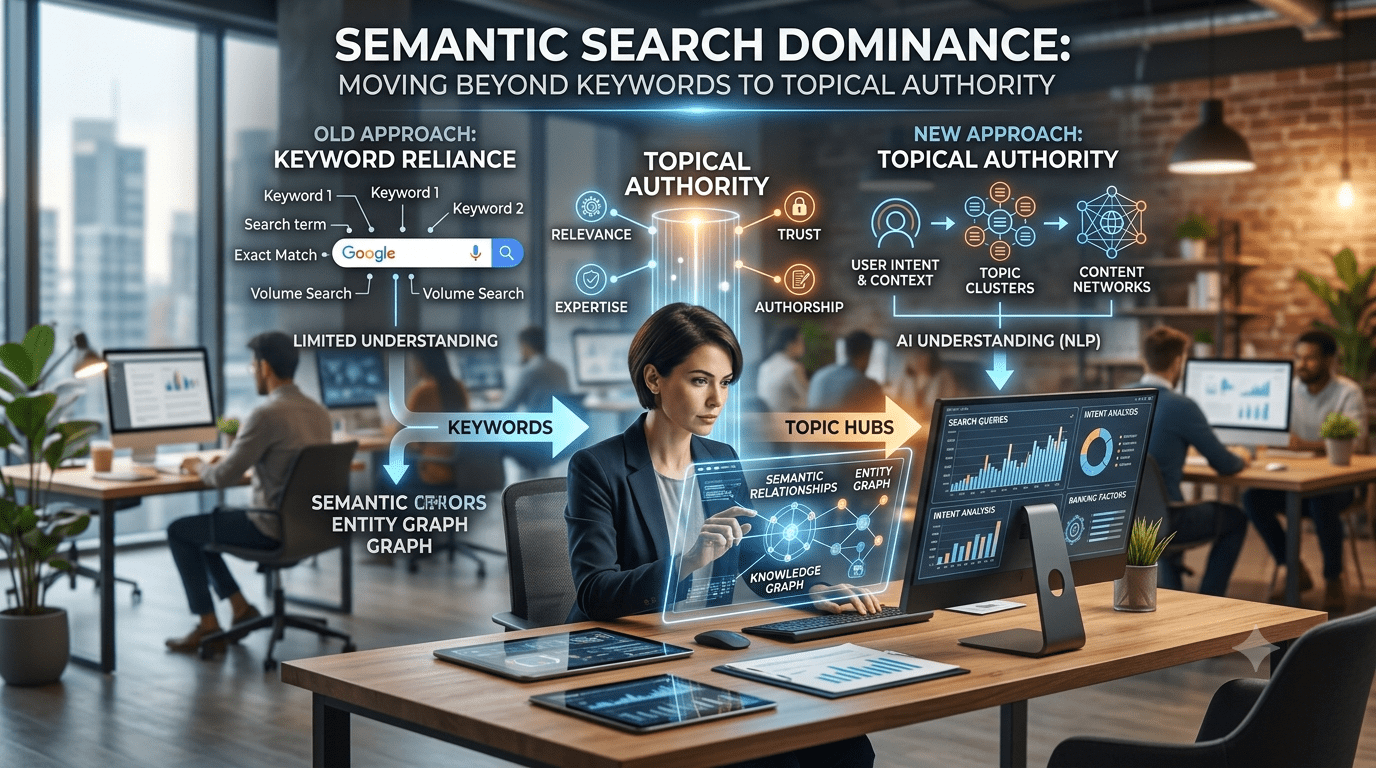

The Digital Fatigue Problem: Why Keyword-Matching Is Failing in 2026
Business owners throughout St. Petersburg and the broader Tampa Bay market are facing an unprecedented shift in search engine mechanics. For over a decade, traditional search engine optimization relied on straightforward mechanics: identify high-volume phrases, place them in page headers, and build baseline directory links. Today, that playbook is completely obsolete. As artificial intelligence models and vector-based retrieval systems dictate search results, superficial keyword targeting yields diminishing returns while customer acquisition costs continue to climb across paid channels.
![A detailed horizontal infographic split into two distinct, contrasting flows that compare traditional search engine optimization against modern semantic search strategies against a clean vector backdrop:
Top Flow – [LEGACY KEYWORD MATCHING] (Muted Grey & Red Scheme):
Database Terminal: Shows an outdated, dusty desktop computer spitting out rigid keyword strings like "cheap shoes nyc" and "buy running shoes".
Content Saturation: Red arrows lead to a chaotic, cluttered pile of duplicate blog posts and articles overwhelming a road.
High Bounce Rates: Leads to a web browser window displaying red warning signs, upward-pointing exit arrows, and frustrated user icons leaving the site.
Lost Rankings: A downward red arrow drops into a dark pit containing a buried trophy, labeled "Page 5" and "No traffic."
Bottom Flow – [SEMANTIC TOPICAL GRAPHS] (Vibrant Teal & Green Scheme):
Semantic Topical Graph: Displays a glowing, interconnected knowledge graph network with nodes labeled with concepts like "Footwear," "Style," "Performance," and "NYC."
Entity Clustering: Luminous green arrows lead to a structured architecture showing pillar pages connected logically to subtopic clusters (e.g., "Entity: Running Shoe", "Attribute: Lightweight").
Intent Satisfaction: Flows into a smiling customer icon with a checkmark and speech bubble reading "Found everything I needed!", labeled "Dwell Time: High."
Market Dominance: A rising green arrow surges upward to a professional standing victorious at the peak of a mountain holding a "Market Dominance" flag, alongside strong upward organic growth charts.](https://socialivymedia.com/wp-content/uploads/2026/08/Screenshot_107.png)
Search engines no longer analyze web pages as isolated collections of text strings. Instead, modern algorithms evaluate websites as interconnected knowledge graphs, measuring depth of expertise, contextual relevance, and entity relationships. Companies that continue dumping generic, keyword-stuffed blog posts onto their websites find themselves buried beneath competitors who demonstrate genuine subject-matter mastery.
Overcoming this hurdle requires engaging specialized SEO Consulting Services engineered for the semantic search era. Rather than chasing individual search terms, forward-thinking organizations build comprehensive topical authority engines. Establishing this structural relevance satisfies complex search intent, satisfies algorithmic quality evaluations, and creates a defensible digital footprint that generates qualified commercial inquiries month after month.
The SEO Diagnostic: Why Traditional Keyword Strategies Collapse
Traditional SEO tactics fail modern businesses because they treat search engines like basic index catalogs rather than sophisticated semantic processing networks. When a prospective client searches for a complex service, modern search engines interpret the underlying entity relationships, immediate user context, and implied next steps. Standard digital agencies often fail to adapt, delivering superficial keyword reports while ignoring the underlying technical architecture and content depth required for semantic dominance.
[STRATEGIST WARNING]
- Isolated Content Silos: Publishing fragmented articles without structured internal linking strategies prevents search crawlers from recognizing your overarching subject expertise.
- Exact-Match Obsession: Forcing rigid, unnatural keyword strings into website copy destroys content readability and triggers algorithmic spam filters designed to penalize manipulation.
When mid-market enterprises rely on outdated optimization packages, they frequently experience stagnant rankings despite continuous publishing efforts. Modern search engines measure how thoroughly a site addresses an entire topic lifecycle—including foundational concepts, specific applications, sub-topics, and direct user solutions. Sites containing shallow, unorganized pages fail to establish necessary trust signals, leaving high-intent commercial queries open to dominant regional competitors.
Furthermore, decoupling search engine visibility from user experience creates massive pipeline drop-off. Ranking atop search results yields zero commercial value if incoming visitors land on disorganized pages with slow load times, unclear value propositions, or sluggish inquiry mechanisms. A proper diagnostic evaluates both algorithmic entity alignment and conversion path efficiency.
The Topical Authority Framework: Engineering Semantic Dominance
Achieving market leadership in modern search requires transitioning from keyword tracking to comprehensive topical cluster engineering. Partnering with professional SEO Consulting Services enables your business to map out complete topic hierarchies, define entity relationships, and build structured digital assets that establish unquestioned authority across your core industry verticals.
Building semantic authority begins with optimizing your core digital architecture. Leveraging targeted Local & Competitive SEO strategies allows regional organizations to capture hyper-local search intent while establishing broad domain relevance. This involves structuring primary hub pages supported by detailed secondary content nodes, connected via logical, contextual internal links that signal complete subject coverage to search crawlers.
![A 3-tier vector flowchart detailing a semantic content and lead conversion ecosystem against a modern teal-to-blue gradient background with circuit-board styling and glowing light paths:
Top Tier (Topical Hub Architecture): Features interconnected node clusters representing "Topic Clusters," "Linked Categories," search magnifying glasses, and a glowing topical graph network, illustrating how semantic topic hubs organize search intent.
Middle Tier ([WEBSITE DESIGN & DEVELOPMENT] Semantic Schema & Structured Data): Displays a central website interface mockup with local map elements, paired with a code block icon labeled "Schema.org (Geospatial metadata, Nested Entities, and Relationships)" and a side callout for "Semantic Structure & Optimization."
Bottom Tier (Dual Conversion Routes):
Left Panel ([SALES & MARKETING FUNNEL]): Features a visual sales funnel routing qualified user profile icons down through conversion checkpoints, with a call-to-action "buy now" button and a metric pill labeled "Funnel Velocity: 85%." Sub-captioned "High-Intent Routing."
Right Panel ([LIVE CHAT CONVERSION]): Shows a live chat widget with a customer support avatar, lightning bolt indicators, a stopwatch graphic displaying "Speed: 98/100," and "Lead Capture: <30s." Sub-captioned "Real-Time Lead Capture."
Luminous green and gold arrows connect the tiers top-to-bottom, illustrating how organized topic hubs flow through structured web design into high-velocity sales funnels and instant live chat conversions.](https://socialivymedia.com/wp-content/uploads/2026/08/Screenshot_108.png)
Publishing disconnected blog posts in hopes of capturing search rankings is a legacy tactic that wastes capital and dilutes domain strength. True semantic dominance requires constructing organized topical knowledge hubs backed by structured schema data and seamless conversion infrastructure, turning organic search presence into an enterprise growth driver.
Supporting this depth of content requires a high-performance web infrastructure engineered through expert Website Design & Development. High-authority sites must incorporate clean JSON-LD schema markup, clear entity definitions, and rapid page speed profiles to ensure search bots index and evaluate content hierarchy without friction. To convert incoming informational traffic into active sales pipeline, integrating custom Sales & Marketing Funnel Design guides qualified prospects naturally from early research phases into high-value consultation bookings.
Capturing maximum market share demands a multi-channel acquisition system. Balancing organic topical expansion with immediate paid coverage via Pay Per Click (PPC) Traffic secures visibility across both sponsored and organic search real estate. Additionally, amplifying authoritative content across digital communities using Social Media Management & Marketing generates natural brand engagement, social proof, and entity validation signals that reinforce organic search performance.
Quantifying Topical Authority: Metrics and Long-Term ROI
Evaluating search engine marketing investments requires shifting focus away from vanity metrics like keyword count toward meaningful commercial indicators: topical share of voice, qualified pipeline volume, and cost per acquisition trends. Continuing to invest in generic content spinning or unintegrated ad campaigns increases operational overhead while leaving critical brand equity unbuilt.
| Scenario | Typical Result | Cost of Inaction | Time to ROI |
| Amateur / DIY Approach | Fragmented keyword focus, shallow content, stagnant domain growth, high lead drop-off | Escalating reliance on expensive paid ads, lost organic market share | 12–18 Months (Uncertain) |
| Social Ivy Approach | Complete topical dominance, entity-driven schema, direct conversion funnels | Minimal—investment creates compounding, owned organic search assets | 3–6 Months |
Industry research published by Search Engine Journal shows that search algorithms increasingly prioritize depth of coverage and entity clarity over link volume alone. Furthermore, technical benchmarks compiled by Moz confirm that websites structured around topic clusters achieve significantly higher average position stability following core algorithm updates compared to sites relying on isolated keyword targeting. Market analyses from Statista consistently demonstrate that organic search traffic generated through authoritative content channels delivers superior long-term conversion rates and lower overall customer acquisition costs.
![A detailed 2-row horizontal comparison infographic contrasting traditional or unoptimized search setups against a structured local revenue engine against a blue gradient background:
Top Row (Unoptimized Search Presence / Topic Cluster Breakdown):
[Topic Cluster Coverage]: Illustrates fragmented, broken maps displaying "404 Error" and "Not Found" messages along with disconnected data points.
Higher Entity Relevance: Shows an unorganized web of entity blocks with broken links and mixed Google map business profile icons.
Algorithm Immunity: Features a sinking ship labeled "Algorithm Immunity" taking damage from a shield marked "UPDATE" and an "AI" chip.
Compounding ROI: Displays a decaying line graph dropping from 25% down to 10%, falling cash, and a cracked safe next to a red "X" icon.
Bottom Row ([Structured Local Engine]):
[Structured Local Engine]: Displays a precise multi-layered map grid, an optimized Google business profile, location markers, and organized data lines glowing with green trails.
Map Pack Dominance: Highlights a mobile search interface featuring a prominent "3-PACK" badge, five-star ratings, and green checkmarks indicating top local search results.
Higher Entity Relevance: Shows structured entity blocks cleanly mapped and routed directly into verified Google business profiles.
Predictable Inbound Revenue: Displays a steep upward-trending green bar chart with labels "Consistent Growth" and "Low CAC," accompanied by stacks of gold coins and a vault filled with cash.
A red line connects the top row's entity network down toward the structured path below, while glowing green arrows flow left-to-right across the bottom row to emphasize steady, compounding growth.](https://socialivymedia.com/wp-content/uploads/2026/08/Screenshot_109.png)
Failing to transition to a semantic, topical search strategy leaves your digital footprint vulnerable to algorithmic shifts and aggressive competitors. Investing in structured semantic architecture secures your market position, protects your brand search space, and builds a sustainable digital asset.
Why Social Ivy Media Drives Real Revenue
Social Ivy Media operates as a growth strategy and digital engineering agency based in St. Petersburg, Florida. We design, build, and deploy high-performing revenue engines for mid-market businesses and regional category leaders across the Tampa Bay area and nationwide. Led by CEO Dion De Lauder, our team rejects superficial agency fluff and vanity reporting in favor of bottom-line financial performance, technical rigor, and transparent pipeline growth.
Our team executes using an AGILE framework, enabling continuous testing, rapid deployment, and data-driven optimization across all client assets. We do not view search optimization as an isolated technical exercise. Instead, we synthesize semantic search architecture, custom web engineering, performance paid media, and conversion funnel optimization into a unified growth platform.
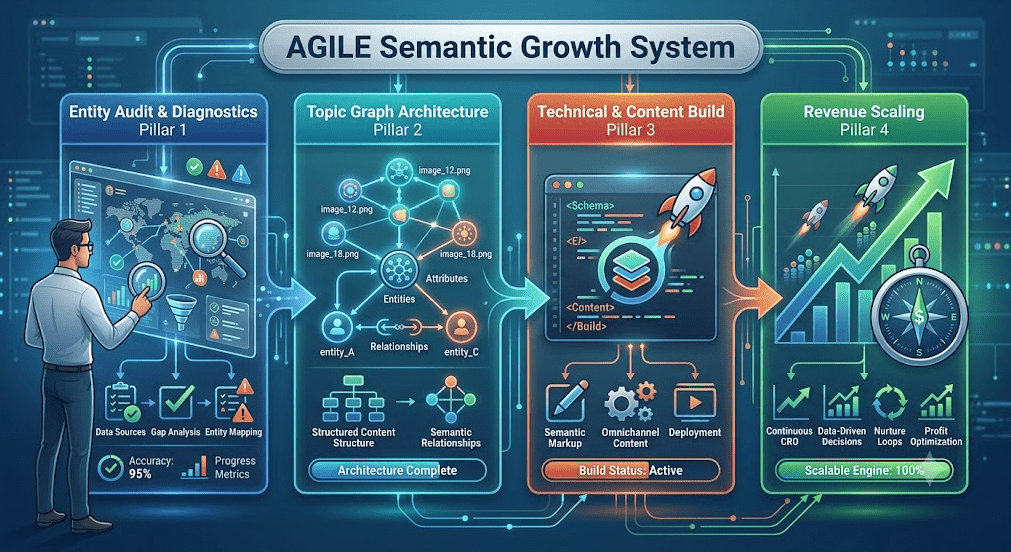
Selecting a specialized local seo company in st petersburg fl with deep technical capabilities provides your business with a distinct competitive advantage. We combine local market insights with advanced search strategy, ensuring your organization dominates both regional search map packs and national topical search queries.
The Four-Phase Execution Roadmap
Transitioning your business from basic keyword targeting to complete topical authority follows a structured, four-phase execution framework designed to deliver measurable improvements without disrupting ongoing business operations.
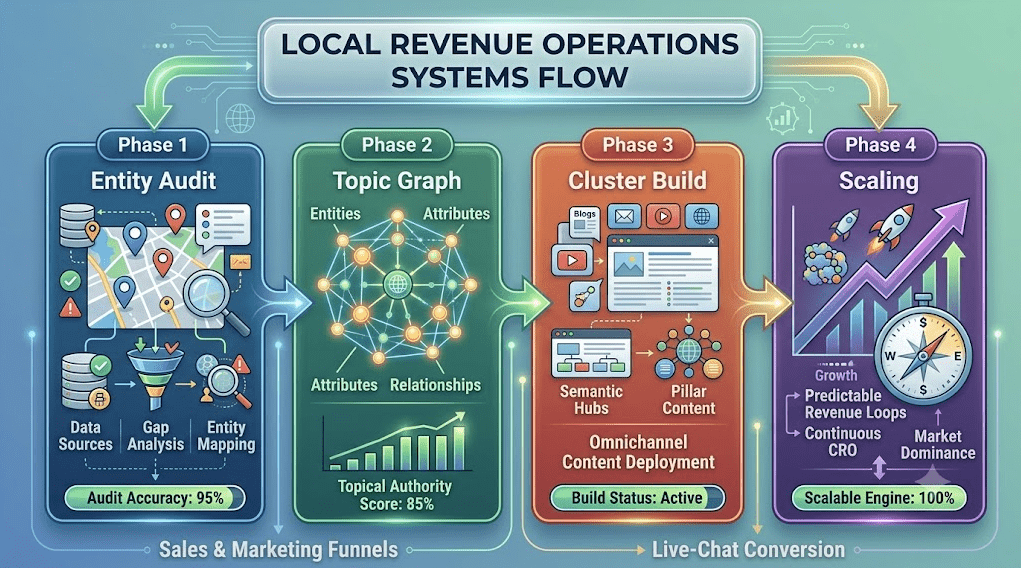
- Phase 1: Entity Audit & Semantic Gap DiagnosticsWe conduct a comprehensive analysis of your existing domain architecture, indexation status, entity clarity, and current topical coverage against top market competitors. We map out missing entity relationships and structural technical bottlenecks.
- Phase 2: Topic Graph Architecture & Technical SchemaOur team constructs a customized topic hierarchy, defining core pillar subjects, supporting sub-topic nodes, and semantic internal linking pathways. Advanced JSON-LD schema is engineered to define your business entities and service structures clearly to search engines.
- Phase 3: Cluster Deployment & Conversion Pathway IntegrationWe build and optimize high-depth content clusters, integrating seamless conversion assets including live chat routing and custom lead forms. Real-time call tracking and multi-touch analytics dashboards are activated for precise lead attribution.
- Phase 4: Authority Scaling & Market ExpansionUsing incoming search performance data, we continuously refine internal link structures, expand into adjacent sub-topical clusters, and optimize user conversion paths. Ongoing performance reviews ensure your organic search footprint scales alongside your overall growth objectives.
The Fix Starts with a Strategy Session
Relying on legacy keyword tactics or unintegrated content production leaves your organization exposed to algorithmic volatility and rising customer acquisition costs. Capturing long-term search market share requires a deliberate, semantic search architecture engineered to establish authority and convert traffic into qualified commercial opportunities.
Our strategic growth audit evaluates your current topical search coverage, identifies entity and technical bottlenecks, and outlines a clear roadmap to category dominance in your primary service lines.
- Primary Action: Reserve your strategic diagnostic session directly with our senior consulting team through 1 on 1 Coaching & Consulting.
- Secondary Channel: Prefer an immediate conversation regarding your technical search architecture and growth goals? Reach out to our St. Petersburg team directly or connect via socialivymedia.com to speak with a growth strategist.
- Tertiary Exploration: Review our specialized local optimization frameworks by exploring our Local & Competitive SEO service solutions prior to your strategy call.
About the Author
Social Ivy Media — Growth Strategy Team
St. Petersburg, FL | Serving Tampa Bay Since 2015
Social Ivy Media is a full-service digital marketing agency based in St. Petersburg, Florida, led by CEO Dion De Lauder. We help local and regional businesses grow through integrated SEO, paid media, social, website design, and funnel strategy — built to convert, not just to look good.
🌐 socialivymedia.com
📍 St. Petersburg, FL