
The Digital Fatigue Problem: Why More Content Stopped Working
For years, the content playbook was simple: publish often, target keywords, wait. In 2026 that playbook is running on fumes. Search results are crowded with near-identical articles, many of them produced in minutes by AI tools, all answering the same questions in the same order with the same cautious advice. Readers have noticed. So has Google.
That’s the context for the EEAT framework, and it’s why we start almost every SEO conversation with it. If your blog has dozens of posts but your traffic is flat, your leads are thin, and competitors with fewer pages outrank you, the problem probably isn’t volume. It’s credibility. Your content may be accurate and still give a reader, or a search engine, no particular reason to trust you over the next result.
Call it digital fatigue. Buyers are tired of generic answers. Businesses are tired of paying for content that doesn’t move the needle. Paid acquisition keeps getting more expensive, organic reach on social keeps shrinking, and search has become one of the few channels where earned trust still compounds over time. But it compounds only for businesses that give it something real to compound on.
The stakes are higher than rankings alone. When a homeowner in Pinellas County is choosing a contractor, or a patient is choosing a provider, they’re making the same judgment Google is trying to model: Does this business actually know what it’s talking about? Has it done this before? Can I trust it with my money, my health, or my home? A site that answers those questions convincingly wins twice, once in search and again at the moment of decision.
The good news is that authority can be built deliberately. The first step is understanding why most attempts at it fail, which is where we go next.

Why Generic SEO Content Fails the Trust Test
Most underperforming content shares one trait: it could have been written by anyone. Strip off the logo and you couldn’t tell which company published it, where it operates, or whether anyone on staff has ever done the work being described.
That’s the core failure. Traditional SEO treated content as a keyword container. You picked a phrase, wrote around it, and hoped volume would carry the day. The EEAT framework asks a different question: what evidence does this page offer that the people behind it are qualified to help?
Here’s what that gap looks like in practice.
No visible author or experience. Posts are credited to “Admin” or to no one at all. There’s no bio, no credentials, no sign that a real practitioner wrote or reviewed the content. For topics that affect someone’s money, health, or safety (what Google calls “Your Money or Your Life” (YMYL) topics), that absence is a serious weakness.
Advice without proof. The article says “regular maintenance prevents costly repairs” but never shows a real job, a real photo, a real before-and-after, or a specific lesson learned in the field. Statements anyone could make carry little weight.
A business that’s hard to verify. The address on the website doesn’t match the Google Business Profile. The phone number differs across directories. The About page is two sentences long. Each inconsistency is small, but together they make a business look less established than it is.
Reputation left on autopilot. A prospect who likes your article will often check reviews next. If those reviews are sparse, stale, or unanswered, the authority your content built leaks away in seconds.
Topical scatter. A site that publishes on everything ends up known for nothing. Ten shallow posts across ten topics rarely build the depth that one well-organized cluster on your core service does.
[STRATEGIST WARNING] The two most expensive E-E-A-T mistakes we see: mass-publishing generic or AI-generated articles with no first-hand insight, and ignoring off-site trust signals like reviews and business listings. The first can drag down how search engines assess your whole site’s helpfulness. The second means that even when your content earns the click, prospects leave before they call, so you pay for visibility and never collect the lead.
None of this is fixed by publishing more. Each problem is a missing piece of evidence, and the solution is to build that evidence systematically.
How to Apply the EEAT Framework to Your Business
Before getting tactical, one clarification. E-E-A-T comes from Google’s Search Quality Rater Guidelines, the document human evaluators use to judge search quality. Google added the extra “E” for Experience in late 2022 and describes Trust as the most important member of the family. Raters don’t directly change rankings; their feedback helps Google evaluate whether its ranking systems are surfacing helpful, reliable results. So E-E-A-T isn’t a score you can check. It’s a description of what those systems are built to reward, which makes it the most useful lens available for deciding what to build.
Industry coverage at Search Engine Journal has tracked this shift closely through successive core and helpful-content updates, and the direction has been consistent: original, experience-based content tends to hold up better than reworded summaries of what already ranks.
Here’s how we translate each pillar into work a business can actually do.
Experience: show that you’ve done it
Experience is the newest pillar and, for most local businesses, the biggest untapped advantage. You have something no content farm has: real jobs, real customers, real problems solved.
Put that on the page. Use original photos from actual projects instead of stock images. Write about specific situations: what you found, what you recommended, why, and what you’d tell a homeowner facing the same thing. Include the details only a practitioner would know, such as the question customers always forget to ask or the shortcut that causes problems two years later. That’s content an AI summary can’t replicate, and readers can feel the difference.
Expertise: make qualifications visible
Every substantive article should have a named author or reviewer with a short bio covering relevant credentials, licenses, years in the trade, and areas of focus. Build a dedicated author page for each contributor. If a technician knows the subject but isn’t a writer, have them review and sign off on the content.
For small business seo, this is often the cheapest win available. The expertise already exists inside the company; it just isn’t on the website.
Authoritativeness: become the reference in your niche
Authority is earned when others recognize you as a go-to source. That comes from depth and from mentions. Organize content into clusters around your core services so one strong pillar page links to supporting articles that answer narrower questions. Earn citations from local publications, industry associations, partners, and community organizations.
For businesses that depend on local search, consistency is the foundation. Moz has published local-search guidance for years, and accurate, consistent business citations are a recurring theme in that work. Your business name, address, and phone number should match everywhere, and your Google Business Profile should be complete, active, and current.
That’s the groundwork of google my business seo st petersburg companies rely on, and it’s where structured local and competitive SEO does most of its early work: making your business easy for search engines to verify and easy for nearby customers to choose.
Trustworthiness: remove every reason to doubt
Trust ties the other three together. On-site, that means a clear About page, real contact details, transparent pricing or pricing ranges where possible, secure pages, and accurate, up-to-date information. Off-site, it’s largely about reputation.
Reviews are where prospects test your claims. A steady flow of recent, genuine reviews, with thoughtful public responses (including to the negative ones), signals that real people use your business and that you take accountability seriously. Strong online reputation management is less about chasing stars and more about building a reliable system for requesting, monitoring, and responding to feedback.
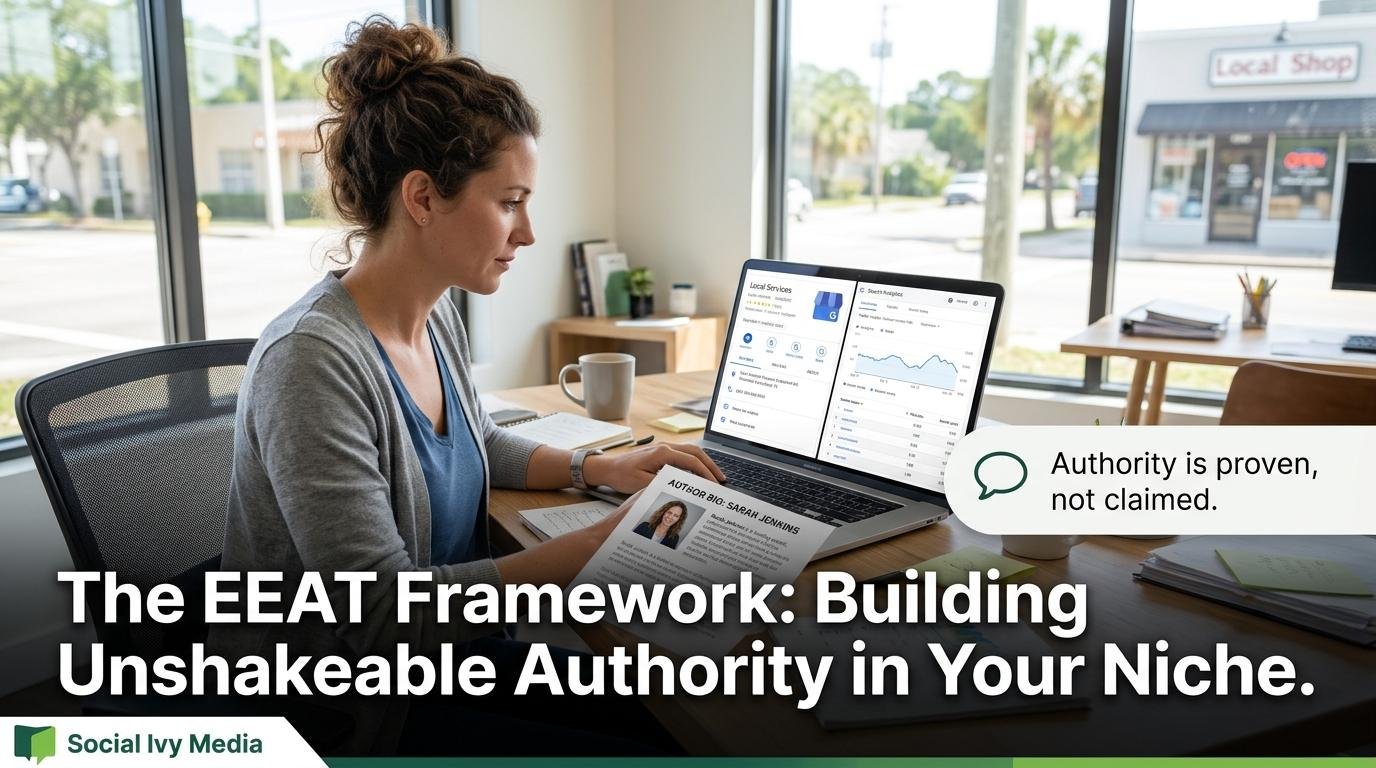
Authority isn’t something you claim on a page; it’s something you prove across every place a buyer checks. Businesses that connect real experience, visible expertise, consistent listings, and an active reputation into one system stop competing on volume and start winning on credibility.
Extend authority beyond your website
Search engines and buyers both look past your domain. Active, expert-led social profiles reinforce that real people stand behind the brand. Short videos of your team explaining a common problem, answering questions, or walking through a job are strong experience signals that also feed your site content. Treat social media management and marketing as part of your authority system, not a separate channel.
Measure what actually matters
Don’t judge E-E-A-T work by traffic alone. Track organic leads by landing page, conversion rate on key service pages, branded search growth, review volume and average rating over time, and rankings for your core commercial terms. Authority work is slower than paid ads, so set expectations accordingly and review progress in quarterly cycles, not weekly ones.
The Real Cost of “Good Enough” Content
“Good enough” content rarely looks expensive. It looks like a reasonable monthly blog budget. Its real cost is in what it fails to produce.
Consider a business publishing four generic posts a month. Over a year that’s roughly 48 articles, plus whatever it costs to write, edit, and upload them. If those pages earn little traffic, convert few visitors, and lend no credibility to the core service pages, the business has paid for a library nobody reads. Worse, a large block of thin content can dilute how search engines assess the site’s overall helpfulness.
Meanwhile, trust is increasingly decisive at the moment of purchase. Statista publishes extensive consumer-survey data on how shoppers use online reviews and ratings before buying, and the broad pattern is clear: buyers check social proof before they commit. A business that ranks but can’t back up its rankings with visible credibility is leaving the final step to chance.
The comparison below uses illustrative estimates, not measured client results. Assumptions: a local service business, a modest monthly content budget, and an average job value in the low thousands.
| Scenario | Typical Result | Cost of Inaction | Time to ROI |
|---|---|---|---|
| Amateur / DIY Approach | High volume of generic posts, no named authors, inconsistent listings, few or unanswered reviews | Estimated: a year of content spend with little organic lead flow, plus prospects lost at the review-check stage | Often unclear, because content isn’t tied to leads or tracked by page |
| Social Ivy Approach | Fewer, deeper pages built on real experience, named experts, consistent local listings, active reputation system, lead tracking by page | Estimated: less wasted spend, since effort concentrates on pages that support revenue-driving services | Depends on industry, budget, competition, and implementation; authority builds gradually, and early signals usually show in engagement and lead quality on key pages |
A simple way to frame it: if one new customer is worth $2,000 to you, a single service page that reliably converts a few extra visitors a month can outweigh dozens of posts that convert none. That’s an illustration, not a forecast. Your numbers depend on your close rate, job value, and market.
The KPIs that tell you the truth
Whoever runs your content, whether that’s you, a staff member, or an agency, ask for these numbers:
- Organic leads by landing page: which pages actually start conversations.
- Service-page conversion rate: the share of visitors who call, book, or submit a form.
- Review velocity and response rate: how often new reviews arrive and how consistently you respond.
- Branded search trend: whether more people are searching for your business by name.
- Rankings for core commercial terms: the handful of searches that bring in paying customers, not vanity keywords.
Authority also has to convert. Once trust earns the visit, the page has to make the next step obvious, which is why we connect E-E-A-T work to sales and marketing funnel design rather than treating it as a pure SEO exercise.
Why Social Ivy Media
We’re based in St. Petersburg, and most of the businesses we work with compete for customers across Pinellas County and greater Tampa Bay. That matters for authority building. Local trust signals, such as community involvement, regional publications, neighborhood-specific service pages, and reviews from nearby customers, carry weight that national templates can’t reproduce. Owners searching for a local seo company in st petersburg fl are usually looking for exactly that combination: technical SEO discipline plus an understanding of how this market actually chooses.
Our work runs on an AGILE marketing approach. Instead of a rigid twelve-month content calendar, we work in focused cycles: audit, set priorities, build the highest-impact pages and signals first, review real data, and adjust. Effort follows what produces leads, and anything that doesn’t gets cut before it becomes expensive.
The agency is led by CEO Dion De Lauder, and the principle behind our work is consistent: rankings create visibility, authority creates trust, and strategy creates conversions. E-E-A-T sits at the center of that chain.
That’s also why authority work benefits from a team that works across channels. The trust problems we diagnosed rarely live in content alone. A strong article loses its value next to an inconsistent business listing, a neglected review profile, a slow website, or a social presence that looks abandoned. Because our team handles SEO, reputation, social, website design, and funnel strategy together, we can fix the weakest link wherever it is. For many clients, seo reputation management and content strategy turn out to be the same project viewed from two sides.
The Journey: What Working Together Looks Like
Audit
What happens: We review your content, author signals, technical SEO, Google Business Profile, citations, reviews, and how each page converts. What to expect: A plain-language map of where your credibility is strong, where it’s missing, and which gaps cost you the most. What we need from you: Access to your website, analytics, Search Console, and Google Business Profile, plus a list of team credentials and areas of expertise. What we handle: The full audit and a prioritized findings report.
Strategy
What happens: We define your core topic clusters, the pages to create, consolidate, or retire, author and reviewer roles, and the reputation system. What to expect: A focused plan with clear priorities, not a content wish list. What we need from you: Time with your subject-matter experts, real project examples and photos, and agreement on who reviews content. What we handle: The roadmap, page briefs, and measurement framework.
Launch
What happens: We build or rewrite priority pages, set up author profiles, clean up listings, and put review requests and responses into a routine. What to expect: Visible improvements to your key pages and profiles early on; ranking movement takes longer. What we need from you: Timely reviews of drafts, short expert interviews, and help prompting satisfied customers for reviews. What we handle: Writing, editing, technical implementation, and listing management.
Optimize and Scale
What happens: We review performance in regular cycles, strengthen the pages that convert, expand clusters that gain traction, and retire what doesn’t help. What to expect: Reporting focused on leads, conversion rate, review trends, and core-term visibility. What we need from you: Feedback on lead quality and closed jobs so we can tell real progress from noise. What we handle: Ongoing content, testing, and scaling recommendations.
Outcomes depend on your industry, budget, competition, and implementation. We won’t promise fixed timelines, rankings, or revenue figures, and you should be cautious of anyone who does.
The Fix Starts with a Strategy Session
The central point of this guide is simple: authority isn’t produced by volume. It’s produced by evidence, the visible proof that real, qualified people stand behind your business and have done this work many times before. The EEAT framework is useful because it forces that question onto every page you publish and every profile a buyer checks.
That’s why we don’t treat the first conversation as a content order or a sales pitch. We treat it as a growth diagnostic. Before you commission another batch of blog posts, it’s worth knowing where your credibility actually breaks down: missing authorship, thin service pages, inconsistent listings, a quiet review profile, or content that never leads anywhere. A clear diagnosis tells you what to fix first, and often what to stop paying for.
Here’s how to take the next step, depending on how you prefer to work:
- Book a strategy session. Schedule a growth diagnostic with our team at [INSERT STRATEGY SESSION URL]. Bring your current analytics if you have them, even if they’re messy.
- Talk to us first. If you’d rather ask a few questions before committing time, call [INSERT PHONE NUMBER] or email [INSERT EMAIL ADDRESS].
- Learn more on your own terms. If you’re still researching, see how trust signals carry through to your site in our approach to website design and development built for credibility.
Whichever route you choose, the goal is the same: stop publishing into the void, prove what you know, and let that proof bring the right customers to you.
About the Author
Social Ivy Media — Growth Strategy Team St. Petersburg, FL | Serving Tampa Bay Since [Year]
Social Ivy Media is a full-service digital marketing agency based in St. Petersburg, Florida, led by CEO Dion De Lauder. We help local and regional businesses grow through integrated SEO, paid media, social, website design, and funnel strategy — built to convert, not just to look good.
🌐 socialivymedia.com 📍 St. Petersburg, FL